
Political Spouses on the Unofficial Office Title
Political spouses inhabit many of Washington’s most crowded offices, often without ever holding one themselves. While their congested workplaces teem with staffers and spectacle, the spousal role itself is defined by absence: devoid of salary, authority over staff, and voting powers.
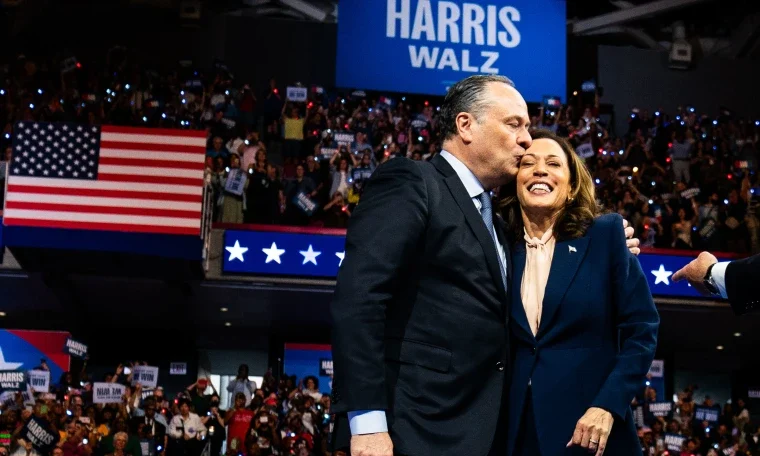
Within this institutional emptiness, political spouses must negotiate the meaning of their role. In an interview with The Politic, husband of Kamala Harris and former Second Gentleman Doug Emhoff reflected on the liminality of his position: “You have to make sure you are a spokesperson for the administration, but you do not always want to be part of the story. Do not screw up and add value if you can.”
As an envoy for Harris, Emhoff embodies a professionalized model of spousal politics through surrogate messaging, issue advocacy, and campaign support. Yet, the recent release of Melania, a documentary chronicling Melania Trump’s response to President Trump’s 2025 inauguration, offers an alternative prototype for political partnership. She is highly visible yet deliberately detached from governance. The First Lady, who produced the film, presents herself as symbolically distant from politics but enveloped in the gingerbread aesthetics of her role—ornamental, carefully assembled, and meticulously staged.
While Emhoff embraces proximity to political power, Melania maintains distance from it, underscoring that the role has no fixed blueprint. As Sarah Bloom Raskin, the wife of Maryland Representative Jamie Raskin observes, “There’s no playbook that the spouses are given when the other spouse enters into public service.”
The capaciousness of the role allows spouses to slide in or out of politics as necessary. During Senator Amy Klobuchar’s 2020 presidential bid, her husband John Bessler became a strategic advisor and campaign stand-in. “Elected officials cannot be everywhere at once. I’ve had to give speeches or attend events she was not able to,” Bessler said.
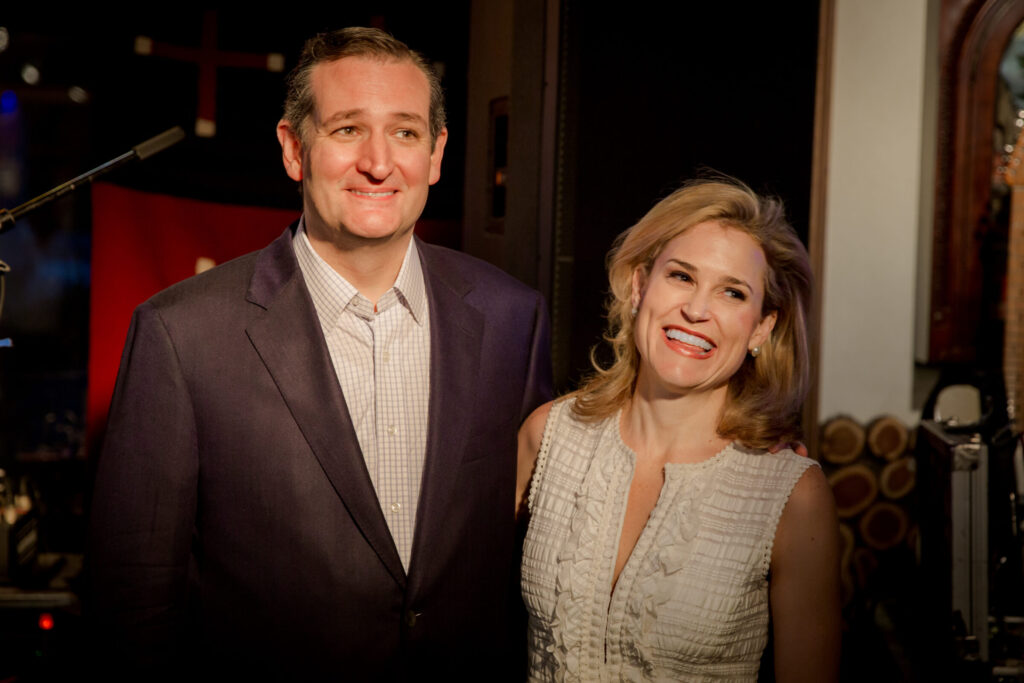
On the contrary, Senator Ted Cruz’s wife Heidi Cruz shared that, despite once considering a run for office herself, her job in private wealth management makes it impossible to fully commit to the public position. “There are spouses who are involved socially. I’m really not at all… partially because of my work at Goldman Sachs,” she explained.
On the Ethics of Ideological Disagreement
Across interviews with The Politic, political spouses described the challenge of balancing public loyalty with private ideological disagreements. Betty Lieu, wife of California Representative Ted Lieu, reflected, “I was a little more conservative, and he was a bit more progressive, but we’ve balanced each other out.”
Yet, intellectual reciprocity only goes so far. For spouses of more polarizing officials, the role often demands a quiet self-restraint. Heidi Cruz recounted how disagreements became fraught when marital solidarity was expected to align with campaign uniformity. “I do not want to impede his agenda if we disagree on something,” she admitted, “but I still have to be out there campaigning for it.”
While Emhoff described broad political alignment with Kamala Harris, he too was admittedly “not 100% in line with 100% of the people in the administration.” Behind the soft choreography of press lines and pantomime of photo-ops, he occasionally negotiated with staffers or declined roles that conflicted with his priorities. Ultimately, these boundaries are tempered by what Emhoff describes as a moral imperative to uphold the administration’s positions in the interest of democratic unity.
Such political forbearance also surfaces in conflicts of interest, where spouses must balance professional independence with political obligation. For example, in 2022, Massachusetts Representative Ayanna Pressley and her husband, consultant Conan Harris, took opposing sides on a ballot question regarding rideshare worker classification. Pressley argued contractor status weakened labor protections, particularly for workers of color, while Conan Harris represented drivers defending the model’s earning flexibility and tax advantages.
The dispute drew widespread coverage, particularly because Conan Harris’s public position was financed by advocacy groups linked to Lyft and other big-tech companies. “We were on two sides of it. The papers wrote about it,” Conan Harris told The Politic. “But we’re both adults. We respected each other’s decision.” The couple ultimately found consensus in creating what Conan Harris described as a “firewall” between their public and private careers: “My business is over here, and her government piece is over there.”
On Public-Sector Conflicts of Interest
However, professional separation is rarely so clean, especially within the public-sector fishbowl. Upon being nominated by President Joe Biden to serve as the Federal Reserve’s Vice Chair for Supervision, Sarah Bloom Raskin encountered fierce opposition from Republican Senator Joe Manchin. Though publicly cast as disagreement over climate-related financial risk, much of the Republican backlash was driven by partisan resentment toward her husband, Representative Jamie Raskin, who led impeachment proceedings against President Trump.
“It triggered these nonsensical, meritless claims about me,” she said. “One spouse can get punished for what I call the ‘sins’ of the other.” In March 2022, she withdrew her nomination. Raskin has since transitioned from public service into academia—serving as a visiting professor of law at Duke University. This shift allowed her individual career ambitions and spousal obligations to coexist without one eclipsing the other.
While these conflicts of interest can strain political marriages, they also encourage collaboration, especially to avoid the perceptions of influence-peddling. For example, in the mid-1990s, New Hampshire joined several states in a legal battle against major tobacco companies for smoking-related illnesses and sought outside counsel. Former U.S. Attorney of New Hampshire William Shaheen recalled that his highly esteemed law firm would have been the obvious choice to represent the state. Under any other governor, “[i]t was a done deal,” he noted. That changed when his wife, then Governor Jeanne Shaheen, intervened: “She figured, ‘Why should I give him money?’,” said William Shaheen. Though his firm ceded $10 million in potential fees, he agreed the decision was necessary to avoid accusations of impropriety.
The dynamic reversed in 2023 when William Shaheen was mistakenly placed on the TSA’s “Quiet Skies” watch list as a co-conspirator with an alleged terrorist. While Senator Shaheen offered to intervene, William Shaheen decided to litigate the matter himself, ensuring she was not accused of backroom favoritism. The Senator still eventually got involved, prompting public allegations of crony advantage despite Shaheen’s unjust terrorist charge.
Betty Lieu also took professional distance to avoid accusations of nepotism. When she ran for the Torrance Unified School District Board of Education, she deliberately declined her husband’s endorsement, despite its political capital. “I did not want people to vote for me because I’m his wife,” she said. “Vote for me because of my credentials.” Now, in her bid for Torrance City Council, she similarly centers her campaign on a record independent of the Congressman, highlighting her work as an educator and local public servant. Paradoxically, while these spouses often limit collaboration to avoid the appearance of preferential treatment, cooperation is sometimes necessary to solve problems created by political proximity itself.
On Breadwinning as Public Service
Many political partners cooperate by separating their professions from the public sphere entirely—building out private-sector identities to avoid conflicts of interest. As Senator Klobuchar’s husband, John Bessler, sees it, “One elected official in the family is probably enough.”

Within this division of labor lies the simpler truth that public office does not cover rent—at least for those without inherited wealth or established lucrative careers. Political spouses often become breadwinners not out of ambition but necessity. “In New Hampshire, when you’re a state senator or a member of the House, you get paid $100 a year,” noted William Shaheen. When Jeannie Shaheen entered politics, the couple made an eleventh-hour decision: “I would make the money, and she’d make a difference,” he said. Shaheen went on to expand his law practice and build more than 20 businesses. Heidi Cruz put it bluntly: “Somebody’s got to make money in the family.”
On Constant Exposure in the Public Panopticon
Yet for every interviewee, the greater burden was not financial strain but relentless public exposure—living and working beneath a panopticon of scrutiny. Spouses inhabit a paradox of overexposure then simultaneous erasure: “We’re hyper visible, but at the same time super invisible… Sometimes we’re just collateral, depending on what the press wants to write,” surmised Conan Harris.
For Emhoff, “vile negativity online” has produced and held especially painful emotional ramifications at home, particularly for his daughter, Ella. “The white, hot scrutiny is so intense and so personal that you get used to it. It almost bounces off you,” he said.
Under an unrelenting public gaze, even grief is regulated. On January 31, 2020, Representative Jamie Raskin’s 25-year-old son, Tommy, died by suicide. Days later, Raskin stepped onto the national stage as chief prosecutor in the second impeachment trial of Donald Trump.
Sarah Bloom Raskin found herself navigating private mourning alongside a sudden influx of caretaking responsibilities that fell to their family during the proceedings. The convergence created an emotionally paralyzing burden she felt was too heavy to share with friends or relatives. “You do not want to hurt the people that you would normally confide in by saying something. It’s the burden of vulnerability,” she said.
Amid scrutiny, public vulnerability manifested in private emotional sacrifices and reconciliations, especially for Emhoff. Although once his family’s primary provider as an entertainment lawyer, he was thrust into a sidelined public role, forcing a recalibration of selfhood within a role defined largely by another’s success. “I was a lawyer for all those years, and all of a sudden, I did not have that. It took a minute to make that transition… and having to do it publicly, where I really could not make mistakes, was challenging,” he noted.
Ultimately, Emhoff set aside personal ambition to embrace a new form of labor: spousal support in service of a shared democratic mission. “You’re there to make sure they win… That’s your job: just to be supportive,” he said.
William Shaheen echoed the importance of avoiding personal aggrandizement: “You’ve got to remember what this is for. At the end of my life, I do not want to say ‘it was for me.’”
Yet spouses were careful to distinguish their support from submissiveness. Raskin noted the frustration of having a complex career reduced to social-media shorthands: “I think it’s hard to show complexity. There is a motivation, often, to make the spouse into almost a meme.”
On Redefining Gendered Support
These public tropes were often gendered, anchored in stereotypes of female dependency or narratives that cast male support as emasculation. As Lieu observed, traditional norms still dictate that women are more often expected to yield their careers. When her husband was appointed, she paused her own, calling it the more “socially acceptable” choice.
Heidi Cruz described how these stubborn assumptions too have trailed her career. “When I walk into a room with Ted, many people do not assume I’m working,” she said. “They assume there’s a trust fund in the family.” Were their roles reversed, she added, “and I was a Congresswoman, they probably would assume that Ted’s a partner at a law firm to pay the bills. That frustrates me.”
Emhoff encountered inverted gendered tropes, rooted in notions of spousal support as uniquely feminine. He described how the far-right cast him as a “beta” or an emasculated campaign prop, which he likened to earlier attacks directed at John Kerry. Emhoff acknowledged that his novelty as the first Second Gentleman drew intense coverage, “fair or unfair.” Female spouses, he argued, received far less attention—especially for policy work. “Usha Vance is an accomplished lawyer. But with her, it’s not being covered. I mean, I saw that she was pregnant. That was the only time I’ve seen her in the news,” he said.

Rather than being constrained, Emhoff reshaped the role on his own terms. “I showed the world that a man could be strong and love his family and be powerful and take a step away from his career,” he reflected. Framed by Time as a new “model of masculinity,” Emhoff turned his position as the first Second Gentleman into political capital. He leveraged his visibility to champion gender equity and combat antisemitism—convening Jewish leaders, backing federal antisemitism strategy, and advocating workplace equality and reproductive rights post-Dobbs.
In an interview with The Politic, Colorado’s First Gentleman, Marlon Reis, the first openly gay spouse to hold a gubernatorial First Gentleman role, described a similar form of policy entrepreneurship. Although Reis felt tokenized as a “symbol of progress,” he leveraged his heightened scrutiny to architect political reform, especially for LGBTQ+ rights. Notably, he used his public standing to raise the state capitol’s first Pride flag in 2019. Within Governor Jared Polis’s “Colorado for All” agenda, Reis also prioritized protections for not just humans but animals, which he believes “emboldened” legislators to pursue stronger safeguards. “This year, a record number of animal protection bills have been introduced,” he emphasized.
On the Politics of the Purse
The soft power of Reis and other political spouses underscores broader paradoxes within the unofficial office. They are expected to be autonomous professionals yet ethically-restrained actors, private breadwinners yet public emissaries, and public fixtures yet powerless spectators.
Living within these contradictions pushes spouses to the periphery of political life, where a breakneck pace and elevated stakes rarely leave space for conventional romantic partnership. And yet what consistently sustains these relationships is not refuge from public life but a shared dependence on—and even attraction to—the churn of contemporary politics. For Betty Lieu, her partnership arose less out of conventional courtship than civic ambition: “I met [Representative Lieu] at a bar, not a drinking bar, a bar association.”Ultimately, while the spousal role is conferred by love, romance often yields to political utility. As private partnerships bend toward public purpose, even small or intimate gestures become strategic choices in service of a shared civic mission. Love becomes less a vessel for political spousalship than a soft accessory to it. Doug Emhoff put it plainly: “There were times where I’d say, ‘I’m never holding your purse.’… I’ll be there if I’m adding value.”