
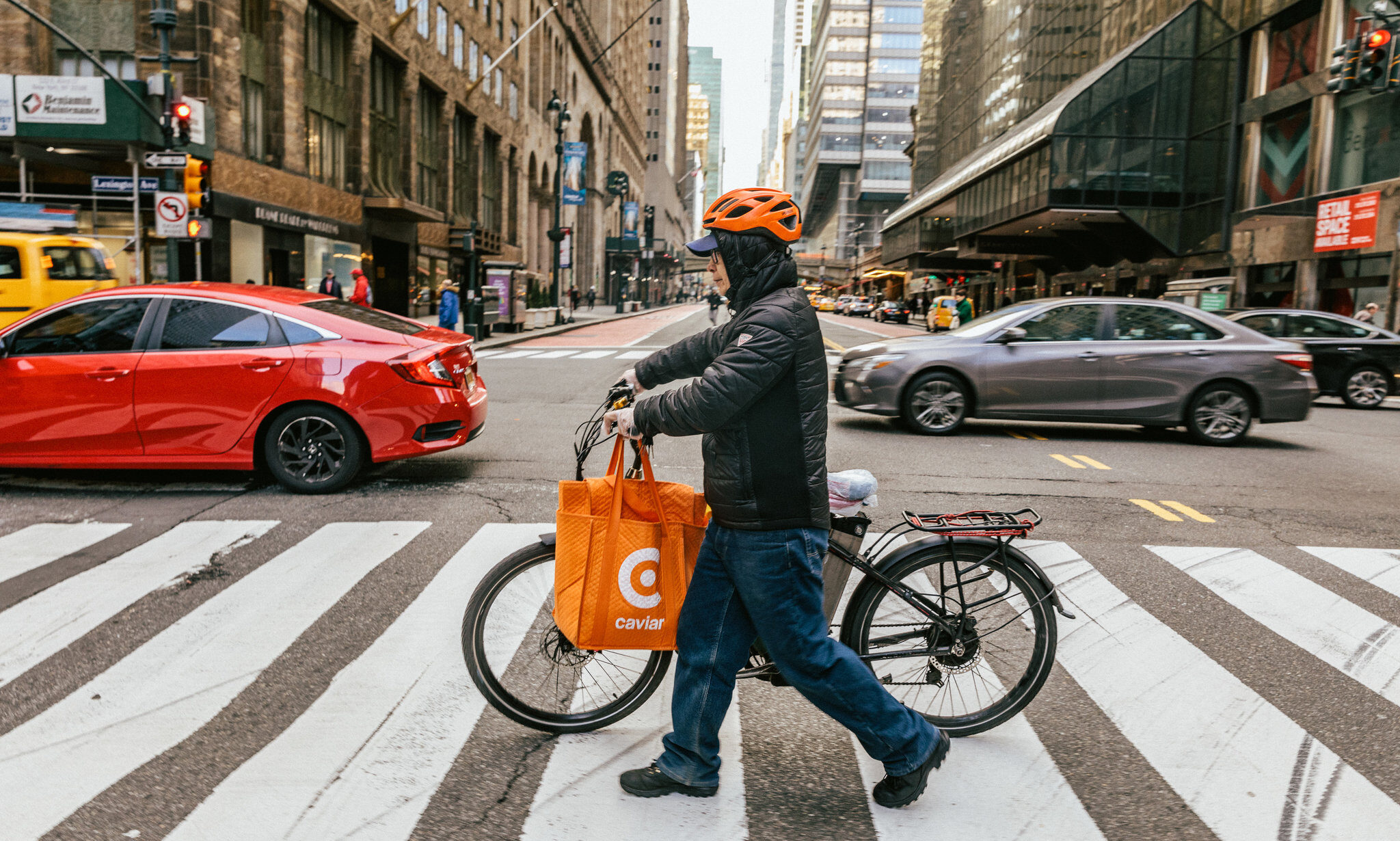
Bryan Banducci / The New York Times
In the Metro Detroit suburbs, on a morning in 2020 he can no longer place, Omar Zahran accepted a DoorDash order for a box of donuts from Krispy Kreme. The drive was roughly 30 minutes each way. DoorDash was offering him two dollars for an hour of his time. He accepted it.
Zahran grew up in New York, but eventually settled in Detroit, where he built a decade-long career in the tech industry doing contract work for Google and a brief stint with LG Mobile. It was the kind of resumé that looked stable—well-paying jobs with regular salaries and benefits. Until it was not. The pandemic hit, and he was furloughed twice in a roughly twelve-month span.“I have to figure something out. I have to make a pivot,” Zahran recalls thinking. He decided to try DoorDash. “I went on their app, signed up, and I was able to start accepting deliveries pretty quickly,” said Zahran, “the vetting process was roughly a day.”
For four months, he dashed five to seven hours a day. “I would treat it like a full-time job,” he said. Zahran soon developed a rhythm: mornings and afternoons chasing the breakfast and lunch rushes, a podcast playing, a red DoorDash bag in the passenger seat. “I would set a daily goal of $100,” said Zahran. Sometimes he would hit it in three hours, sometimes it would take seven. He could never predict which one it would be. He felt that DoorDash had no interest in his individual success. “The relationship is very hands-off,” he said, “it was kind of like, ‘you’re approved, go.’”
Zahran’s story fits a pattern that Dmitri Koustas, Assistant Professor at the Harris School of Public Policy at the University of Chicago, says became common during the pandemic. “There were workers who lost their jobs due to the COVID disruption,” he said, “and at the same time, there was this massive demand shock for delivery services.” In April of 2020, combined sales for major delivery services grew 162% year-over-year.
While the pandemic was devastating for Zahran and others alike, it also interlaced food delivery apps within the broader fabric of American life. As of March 2024, DoorDash alone controlled 67% of the American food delivery market. Since the pandemic, apps like DoorDash and Uber Eats have become a major avenue through which Americans access food.
Kristen Hawley, a freelance food business journalist, has witnessed this transformation up close. “There’s pretty much no facet of the restaurant industry that has been left untouched,” said Hawley. “Chipotle, for example, has a whole second line out of view from their main area where people only work on food for delivery.”
Matti Gellman, a food reporter at The Baltimore Banner, tracks this restructuring at a local level. “A lot of business owners describe it as a parasitic relationship,” she said. “These businesses can’t survive without these apps…but at the same time they’re giving away large percentages to the apps and those rates are increasing.”
The idea that first built this empire was enticing and seemingly straightforward: flexibility. The apps offered people the freedom to be their own bosses and work whenever they wanted, and that pitch landed. Luis Dominguez works in Information Technology (IT) at UT Austin, while dashing on the side in the San Marcos area. “I’m my own boss,” he said. “I can choose my hours. I can work whenever I want.” For Dominguez, food delivery is a side hustle that offers him a bit of extra spending money.
Dominguez, unlike Zahran, began dashing from a place of relative stability. He had a salary and could stop whenever he wanted to. For Dominguez, the promise of flexibility was real. But even from his position of relative comfort, he arrived at the same conclusion as Omar: the math does not change based on why you decide to sign up.
The pay structure for food delivery drivers is, by design, difficult to summarize. It varies by state, by market, by time of day, and by a rating system that drivers seem to understand only partially. For DoorDash drivers specifically, Zahran remembers earning three dollars per delivery as his base, and then having to make up the rest with tips. This is more difficult than it seems. “70% of customers don’t tip,” Zahran shared. He explained that among customers who do tip, the amounts are often very low and not proportional to the amount of time or money spent on the driver’s part. On the other hand, Dominguez developed a $1-per-mile rule: if an order does not pay at least one dollar for every mile he drives, then it is not worth taking.
However, the number of orders a driver receives is dependent on their order acceptance percentage. When the acceptance rate drops, the algorithm stops prioritizing that driver, sending them fewer orders, including fewer high-paying ones. “It’s this gamified system where you feel like you have to take it,” said Zahran.
Hawley offers a more direct explanation. “Service work is generally underpaid and undervalued,” she said. “You’re relying on the graciousness and generosity of the customer, which is clearly proven not to work in the service worker’s interest most of the time.”
Gellman framed Hawley’s observation in terms of what the model requires to function. Apps need high order volume in order to keep money and investment flowing. However, high order volume requires low visible costs for consumers, which means that those costs must be distributed elsewhere, onto restaurants and drivers.
Bare-bones pay, the absence of benefits, and the separation between company and worker are all characteristics of the gig economy. Peter Price, a DoorDash site manager in south Florida, explained the company’s structure as a decision driven by cost and liability. W-2 employees are those formally employed by a company, receiving regular paychecks. They require benefits and create legal obligations in the workplace environment. 1099 contractors, like delivery drivers, do not. “W2 employees would be way more costly,” said Price. “Then there’s liability. DoorDash separates itself from the dasher when there’s an issue. They’re 1099 contractors because, for example, we don’t know how people drive. So you don’t want somebody going crazy, and then DoorDash is responsible if something goes wrong.”
Price also noted that DoorDash does not track whether its drivers are dashing full-time or part-time. “DoorDash doesn’t mind that gray area, because it gives them the freedom to say that they don’t really have to take care of the driver, as long as they’re a contractor,” he said.. “These apps have no vested interest in tracking that data, because if they do keep track of it, there’s always the potential threat of legal misclassifications,” Mehmet Cansoy, Associate Professor of Sociology and Anthropology at Fairfield University, explained If you don’t keep track of that data, you won’t be forced to share any findings.”
While Hawley does not believe that food delivery companies are inherently immoral, she acknowledges the gap between their rhetoric and their practices. “The way they work most effectively is not necessarily the most ethical version of what this could be.”
***
Zahran describes food delivery as isolating. He listened to podcasts to fill the silence, but it was still there. “About seven out of ten orders prefer you to leave their food at the door, so there’s no physical handoff…it begins to feel like you’re on an island.”
“I feel like a lot of people don’t see the dasher. The food’s just there,” he said. He will often message customers jokes, saying he got stopped by a train or that he would “Tokyo Drift” over to them, to make himself seem normal and human. Sometimes it works, but most of the time, the door stays closed. “The human aspect is kind of taken out of it,” said Dominguez. “Maybe that’s why people don’t tip.”
The tipping question cuts to the core of how the business model functions—and who is harmed when it is threatened. When New York City moved to require that the tip prompt appear before an order is placed rather than after, DoorDash retaliated aggressively. “They didn’t want to do that because that raises the starting total of delivery before the diner pushes the order button,” said Hawley, as DoorDash claimed that higher visible prices would deter customers from ordering. Their argument went a step further. “They claimed that if there were fewer orders, they would have to reduce the number of people delivering the orders,” said Hawley. “Therefore, they claimed that the city would actually hurt the hourly workers.”
These companies are especially protective of their business because of their profitability. Food delivery companies all offer similar services, forcing them to spend heavily on ads, discounts, and promotions to attract and keep consumers. At the same time, their operating costs often exceed the commissions charged to restaurants. “DoorDash only started turning a profit recently…it took a really long time to get there, so I think they’re extremely protective of their bottom line,” said Hawley. “When a third party like the government puts restrictions on business, their immediate argument is that it hurts the drivers because the government is not allowing their business model to function as intended.”
It is a logical argument. It is also an argument that allows food delivery apps to position driver welfare as something they get to define on their own terms.
The removal of face-to-face interaction affects not only tipping culture but also reshapes the entire relationship between the customer and the worker, making exploitation easier to overlook. “So much of people’s experience now is about convenience,” Gellman said. A large part of this convenience culture is that the true work of food delivery drivers goes largely unnoticed by the general public. “Unions have spoken out about their rights, but there hasn’t been a lot of movement. As these apps become more prominent, people will start questioning what a good model really is…and the apps that connect consumers with food will have to acknowledge the role that drivers play.”
***
The history of American gig worker protections has largely been a history of those protections failing to materialize. In 2019, California passed Assembly Bill 5, which would have required companies like DoorDash, Uber, and Instacart to reclassify their drivers as employees. The apps responded by investing roughly $200 million into Prop 22, a ballot measure that classified gig workers as independent contractors while offering limited benefits, with DoorDash alone contributing roughly $48 million.
The existing labor laws that cover American workers were largely enacted/implemented during the New Deal Era, notably the National Labor Relations Act (1935), which protected workers’ rights to unionize and bargain with employers. Independent contractors are notably absent from the protections provided by the NLRA. Many of the protections provided in the NLRA were left up to the states just 12 years later, when the Taft-Hartley Act (1947) amended the NLRA to restrict union power. The NLRA gave employees the right to bargain collectively, the Fair Labor Standards Act established minimum wage and overtime protections, and the 70s brought the Occupational Health and Safety Act, which set standards to protect workers from hazards. All of these assumed a wage-and-salary relationship. None of these protections were designed around a workforce classified almost entirely as independent contractors.
Independent contracting has always existed. “In 2000, there was a similar rate of independent contracting as there was in 2012 before the rise of platform gig work,” said Koustas. What changed was the sudden growth and concentration of independent contract workers due to the rise of these platforms. “Platform gig work is the only source of increase in independent contracting in the last 25 years,” he explained.
Cansoy attributes the lack of regulation to uncertainty among policymakers about how to respond to these companies as a new economic force. By the time regulators recognized the need for legislation, companies had already begun spending large amounts on lobbying. The result was a set of companies that proved incredibly difficult to rein in.
A large part of Cansoy’s research focused on earning heterogeneity—the wide variation in how much gig workers earn, how many hours they work, and what they want to get out of gig work. “If you don’t have shared interests, that’s a problem for workers. Some people only want to do this for four hours a week. Those people aren’t going to unionize or want to collectively organize.”
“80% of people are doing gig work alongside some other wage or salary income, while 20% of people do it full time,” said Koustas. Someone like Dominguez, part of the 80%, with a salary job who delivered on the side for extra fun money, and someone like Zahran, who delivered full-time to cover all expenses, are technically the same kind of worker in the eyes of the law. In practice, their interests are different, and the gap between them makes collective bargaining all the more difficult.
Cansoy does see this heterogeneity narrowing—but not necessarily in favor of workers. The demography of the gig workforce has become more uniform. “It does seem to be boiling down to a much lower-status, lower-paid workforce,” he said. Koustas agreed, “These jobs have very low barriers to entry, which is appealing to immigrants…it’s a job where they can make money immediately.” While a more homogeneous workforce would theoretically benefit all workers, the shift towards a poorer demographic might reduce their capacity to act and voice their interests.
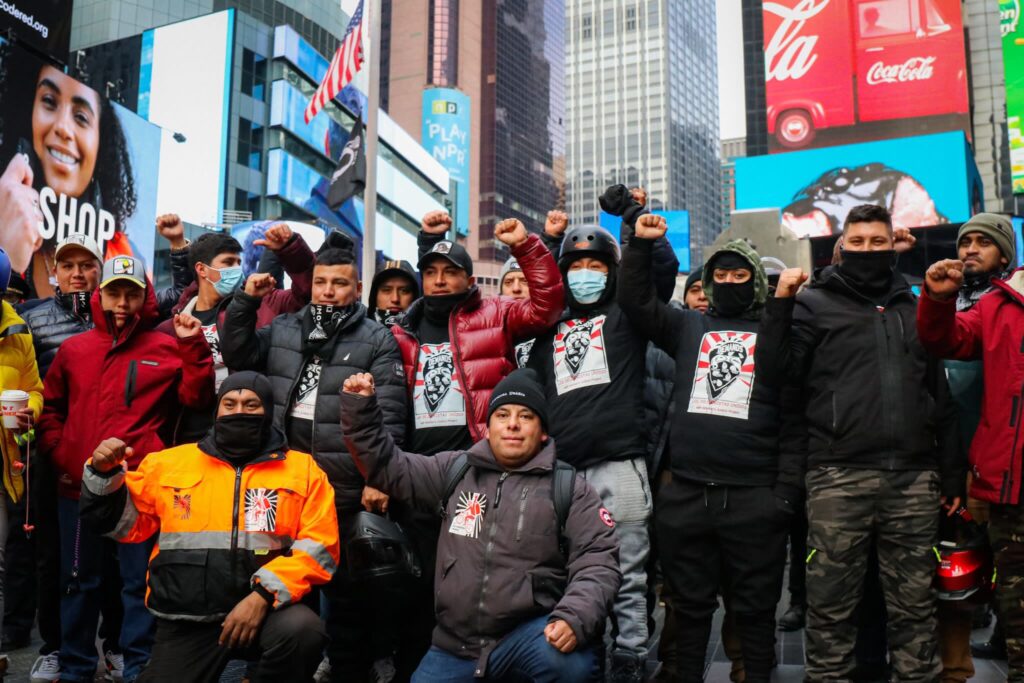
Los Deliveristas Unidos / Adrian Childress
One of the most promising developments, according to Koustas, is the recent push towards unionization for rideshare drivers in Massachusetts. “We’re seeing the drivers organize, and at least some of the major companies have promised not to interfere with those efforts,” he said. “That’s an exciting area for workers and firms to talk to each other more, and for workers to have more collective bargaining power.” The gap between what exists and what could be is not a matter of feasibility; rather, it is a matter of who has the leverage to bargain—and right now, delivery drivers do not.
***
Zahran quit dashing full-time after four months because he got a job offer from Motorola. Dominguez is still dashing, still picking up shifts when the timing works.
What both men describe is less a betrayal or a trick than a gradual clarification. The gig economy promised flexibility, and flexibility—in some sense—is what it gave them. The freedom to work whenever they wanted. The freedom to decline an order and accept a vague algorithmic penalty in its place. The freedom to be the main bearer of costs that companies did not cover until recently. Flexibility and precarity are not entirely different; in fact, they are the same feature. This is the model.
What makes this hard to regulate is not ignorance. Lawmakers understand the structure now. Researchers like Cansoy and Koustas have documented it at length. Workers living it daily, like Dominguez and Zahran, understand it better than anyone. The core of the problem is that costs are diffuse, profits are concentrated, and those bearing the costs have no leverage over the people making the profit.
Right now, someone is probably in their car or on their bike with an insulated bag next to them and a podcast in their headphones, delivering an order that was probably not worth taking. They know the math is not in their favor. But they will accept it anyway. Maybe rent is due, maybe they’re saving for a trip. That decision, made countless times each day, is the gig economy.