
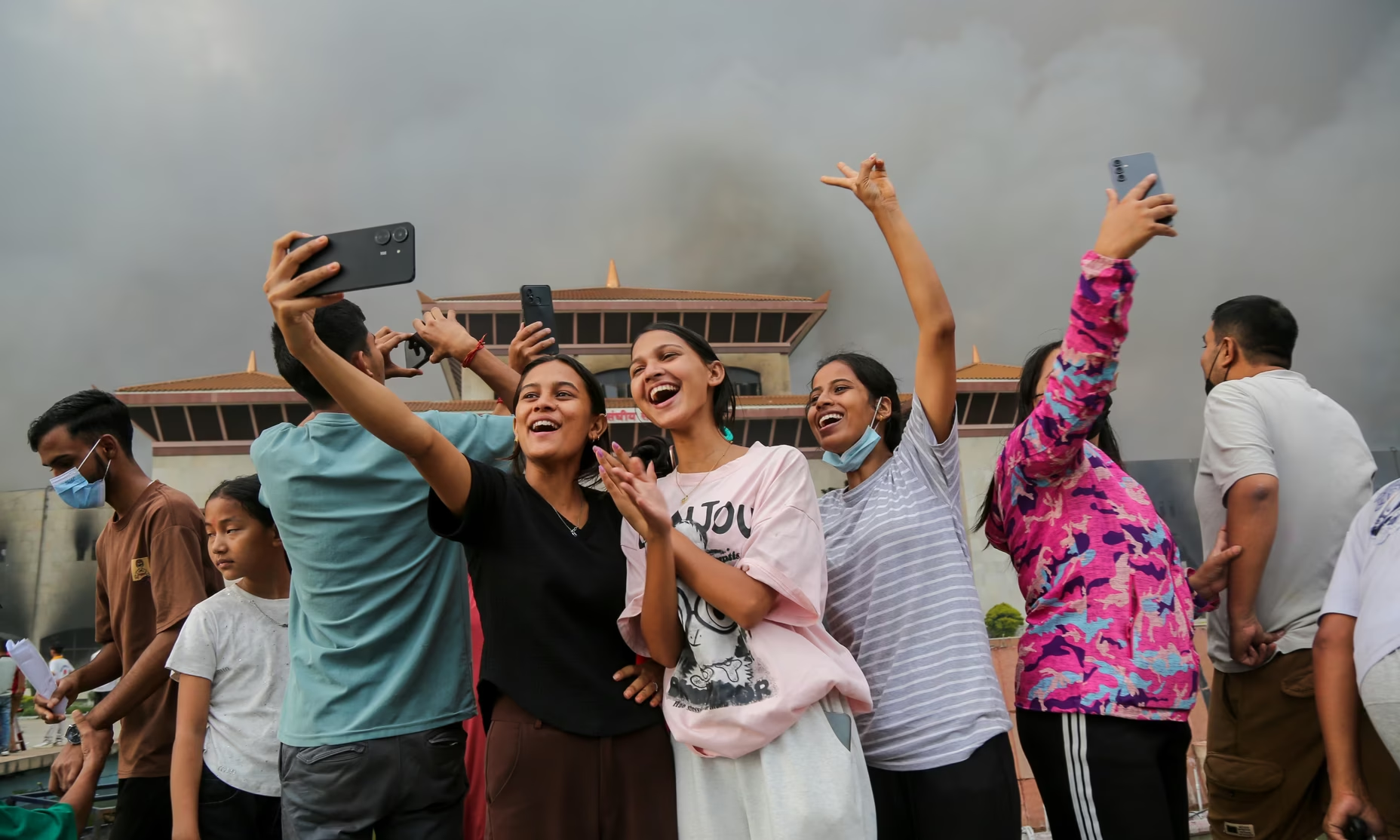
In September 2025, instead of taking selfies at a concert or a soccer match, Nepali Instagram was full of teenagers taking photos in front of the burning ruins of their country’s parliament.
Nepal has a long history of both economic and political instability, leading to large amounts of both internal and external migration. In the fiscal year 2023-2024, 741,000 Nepalis obtained authorization to work overseas, joining the millions already working outside the country. Anusha Khanal was one of the many youth who left Nepal for a better life in Europe, only to return nine years later and find the country still plagued by economic and political issues. A year after her return, on September 4th, 2025, the government of Nepal shut down access to many social media platforms due to their failure to register for a program that would increase the government’s ability to regulate what was shown on the companies’ platforms.
After the ban was implemented, widespread youth protests broke out across Nepal, to which the government often responded with brutal force, killing dozens, including several children, and injuring over 2,000 people. As an additional measure to quell the protests, the government lifted the ban on social media. However, this move backfired as renewed access to social media allowed the protestors to increase coordination and popular mobilization. The protestors did not capitulate, setting ablaze the national parliament, the Supreme Court, mainstream journalism agencies, and other symbols of the Nepali establishment as the military looked on. On September 9th, with the army’s assistance, the protestors forced the prime minister to resign and flee the country, and the unrest subsided as demonstrators declared victory and a transitional government was established. Elections will be conducted in March 2026.
***
Social media has increasingly become a conduit through which Nepalis express their long-running discontent with government corruption and the country’s perennial economic crises. Since the decade-long Maoist insurgency that started in 1996, the economy has consistently experienced low growth due to a myriad of factors. Khanal stresses the importance of social media as a tool for self-expression, remarking that “social media provides that space for everyone to tell their own story,” which has revolutionized politics in the landlocked country she calls home. She works at Gen Z Alliance, which coordinates Gen Z advocacy groups and utilizes social media as a tool to promote government accountability and political awareness.
Social media’s presence in all aspects of Nepali life cannot be understated: it is utilized not just for personal enjoyment and political organization but is also vital in work life. Dr. Kathryn March, a Professor Emerita at Cornell and an expert on Nepal, notes that social media is important to Nepali migrant workers, who make up 14% of Nepal’s population, in two ways. First, it proved invaluable “for communicating and keeping abreast of where people and opportunities [for work] are.” In addition to helping secure employment, social media helps migrant workers, who are often susceptible to stress and mistreatment, connect with their family members back home. March continues, “the conversation that they can have with their wife or their mother or their brother or their school friend is often the most important moment of their day.” Many Americans have been raised to believe that social media often detaches youth from their communities; however, for Nepali youth, who have no other alternative, social media is the only thing connecting them to their community after economic factors have forced them to live in a foreign country.
Social media, while presenting an opportunity for Nepali youth to connect with their communities and express their frustrations, does come with its downsides for both democracy and press freedom. Merlyna Lim, a professor of Communication and Media Studies at Carleton University in Toronto, notes how “there are a lot of steps towards installing a democratic system…You need more than social media,” She continues, “Deliberation is slow, not rapid, which is the antithesis of social media.” The 2006 protests that followed the end of a decade-long Maoist insurgency and led to the reinstatement of parliament, eventually culminating in the abolition of the monarchy, were fundamentally different in nature from the contemporary youth movement. While the protests in 2006 were supported by exiled organized republican parties, the recent demonstrations in Nepal lacked the same degree of centralized leadership. Consequently, it remains uncertain how the protestors will ensure their demands are met now that they have dispersed.
Dr. Richard Bownas, a Professor of Political Science and International Affairs, postulates that the sheer numbers of different movements may cripple the reform movement: “Inevitably, what we already see is these groups trying to form their own parties…because they’re all forming these little clusters of mini parties, that’s going to open a way for the old traditional parties.” He even questions the motivations of some of the protest leaders themselves: “It’s very naive to suppose there’s a bunch of idealistic young people who are just fighting for justice.” In actuality, he argues, many of the leaders of the protestors often appear no more altruistic in their motivations than the members of the political establishment they fought to replace.
***
Khanal is wary of how the social media ban has been portrayed as the sole cause of the protests, which she views as “a very reductionist way of thinking about it.” She rejects the claim that people came into the streets merely because of the recent restrictions on social media. She does, however, note that “the social media ban was a reflection of her country’s transition into autocratic tendencies.” She points out a variety of issues that plague the country’s youth: “the basic infrastructure and services that a citizen requires to live in a country are problematic. Inflation is really high. There’s low employment, and …compensation is an issue. People hold multiple jobs to make a living…in general, there is a sense of deep dissatisfaction towards the state and those who run the state.” She goes on to stress how “the unrest that brought us to the streets was not temporary or a recent thing. It was a compounding effect of all these years,” She emphasized that the root cause of the protests is what the media has ignored, namely “the years and years of structural violence, the inequality that is rampant, the corruption that is rampant, and how difficult it is for an ordinary person to have a decent quality of life.”
Dr. March also notes how social media was not the first medium to facilitate the spread of radical new ideals. She explains that for most of the 20th century in Nepal, “all forms of media were state-controlled…People had very little idea about the rest of the world until…after 1990.” The introduction of foreign free media was revolutionary. “When we talk about the media explosion in Nepal, it’s not just what many Americans mean, especially when we talk about social [media], but any kind of knowledge about the outer world.” Nepali DW correspondent Lekhanath adds that the introduction of free media did not necessarily mean information was fully depoliticized. In email correspondence with The Politic, he writes that “Many journalists are directly affiliated to one or another political party, promoting the politicization of media institutions and shaping the media content.” Despite this, he explains that social media “democratized access to information and opened new spaces for citizen voices—especially for younger generations who felt excluded from traditional media.”
***
In addition to some media outlets misrepresenting the protests as being solely caused by the social media ban, many outlets depicted the protests as a result of a mix of Hindu nationalism and pro-monarchy sentiment—another worrying trend in disinformation. After the abolition of the monarchy, reactionary Hindu nationalism has surged in Nepal, which has proven a threat both to Nepal’s significant non-Hindu minority and to members of traditionally marginalized ethnic groups. Dr. March notes that: “[Before the 2008 elections that led to the abolishment of the monarchy], high-caste Hindu communities constituted about 10 to 12% of the population, and they literally had 99% of the teaching positions and 100% of the government ministerial positions.” As a result of the upset victory of the Maoists in the 2008 elections, high-caste Hindus began to see their traditionally privileged status challenged. While some people harbor pro-monarchy sentiments in Nepal, it is far from the majority, and its prevalence in reports on the protests may even be the result of foreign influence.
Dr. March notes that “there is some support for the monarchy…according to some sources, it is directly funded by Narendra Modi [the prime minister of India].” Pandey agrees that some foreign outlets “misread the protests through familiar ideological, geopolitical & conspiracy frames—seeing them as either a pro-monarchy backlash or a rise in Hindu nationalism or a Western-backed color revolution…The movement is better understood as a post-establishment revolt than a reactionary one.”
Ujjwal Acharaya, a former BBC correspondent and the director of CMR Nepal Journalism Academy, concurs that India is trying to push a false narrative: “We see this kind of information is spreading in Indian media, where they try to project this Gen Z protest as pro-monarchy, a pro-Hindu kingdom, or a pro-Hindu nation. There were even some social media users in India who tried to portray it as a pro-Modi protest.”
While noting that social media has been a tool of information democratization, Pandey also points out that it has its downsides. In email correspondence with The Politic, he wrote, “It has also made journalism more fragile. The speed of virality often outpaces verification, pushing newsrooms toward sensationalism and click-based metrics.”
He is not the only Nepali journalist who views social media as a double-edged sword. Acharaya, who also serves as the Project Lead of NepalFactCheck, an organization dedicated to fighting online disinformation, believes that social media is a boon for democracy in Nepal. Still, he also fears the rising amount of misinformation he has encountered in his work. He notes that while he is concerned about malevolent actors abusing social media to spread information and propagate false narratives, he believes that if the right steps are taken, social media can remain a positive tool for organizing. However, Lim demurs in his assessment of social media as fundamentally democratic, arguing that social media can just as easily be used in anti-democratic ways, “especially in places that are authoritarian…[while] the Nepali government is weak right now, very soon they might begin to work with platform companies, like how the Indonesian government worked with Tiktok to get database of activists and do some legal cracking.”
***
Beyond Nepal, Dr. Lim worries about how the very algorithms behind social media are responsible for amplifying populist and extremist movements across the world. “You need to hate something in the populist playbook. You need to have an enemy in order to be unified. With the emotional exploitation of market branding, you still have to use populist language, a populist strategy, and populist campaigns to be visible and popular on social media.” She further explains how this has led to politicians gearing their political messages to cater to algorithms, which she views as “not good for the public’s discourse. It means that it only amplifies the most extreme, oversimplified narratives, rather than reason, logic, and complex thinking.” Due to these worrying effects, the algorithm’s role of pushing extreme viewpoints raises questions of whether the introduction of social media into the political sphere is beneficial for countries that already have established democratic systems, and if more traditional ways of political dialogue are indeed less effective in promoting good and popular governance.
Despite Nepal’s precarious state, Khanal believes that the proper use of the media will be vital in creating a new Nepal better suited to serving its people’s interests. She notes how one symbol, a pirate flag taken from a Japanese anime, can be seen as emblematic of the overall spirit of the protest movement. “The idea of using the one-piece flag came from the characters in this anime. It’s about friendship, it’s about freedom, it’s about them pursuing a dream, and how each character is fighting for their objective.” The adoption of this symbol is a testament to the popular and bottom-up approach that these protests have taken. It also reveals the unifying force the media has on people. “In countries like Nepal, where government bodies are captured by very small groups of political elites, this symbol of resistance showed that if you trust in your work, if you have passion, and if you’re true to yourself, then anything is achievable.”