
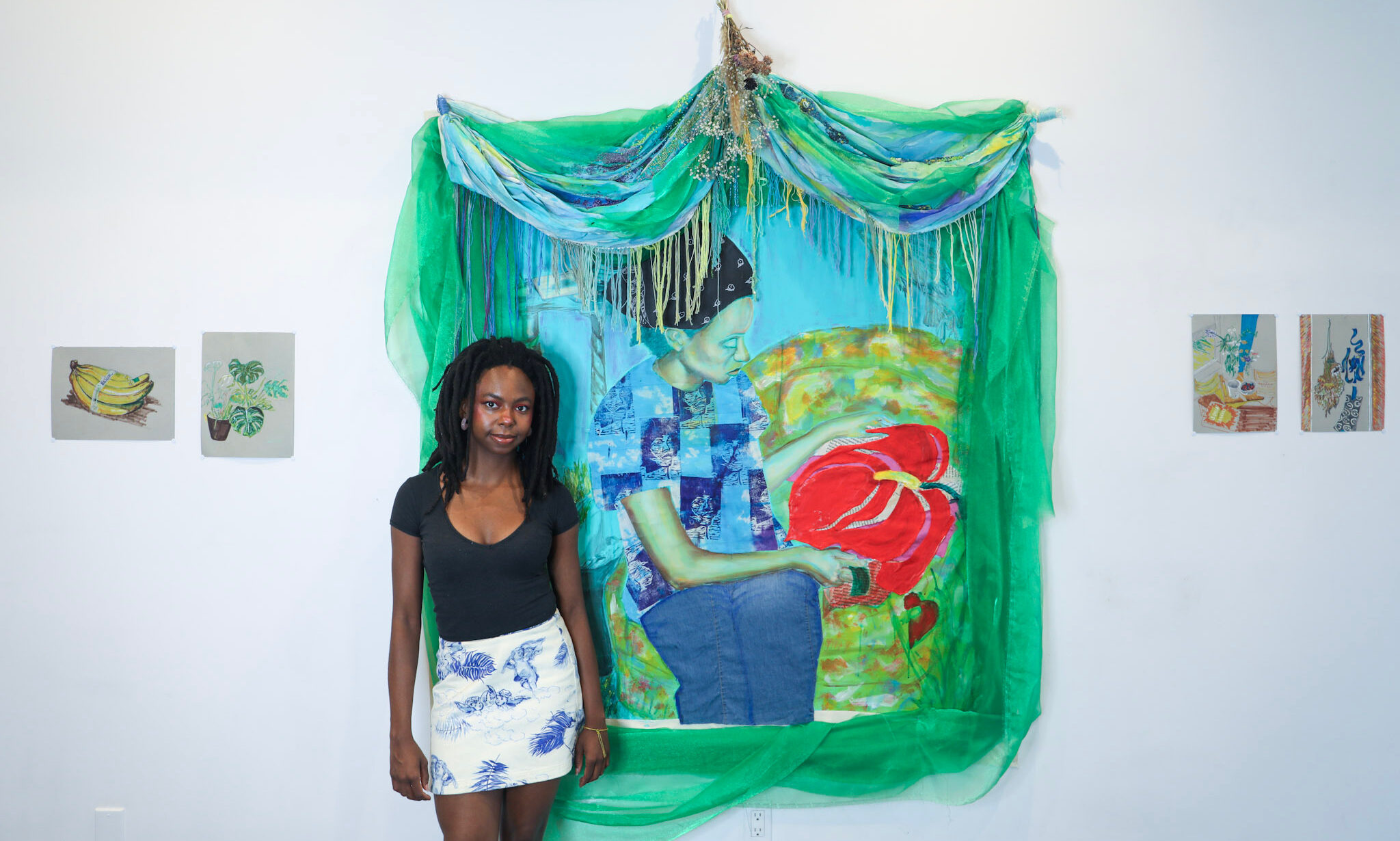
Isis Davis-Marks is a multidisciplinary artist born in Harlem, New York, in 1997. At Yale College, she studied philosophy and visual art. Her work spans the disciplines of writing, painting, and fiber arts, focused upon investigating manifestations of love and ancestry throughout time and across race, femininity, and class. Her writing has been published in magazines including Smithsonian Magazine and Cultured Mag, and her art has been exhibited in museums and galleries such as the Brooklyn Museum, the Yale School of Art, and La Loma Projects.
Can you please tell me about yourself and your artistic journey: Why did you start creating?
Since I was a child, I’ve always gravitated towards visual art, and also literature. I was definitely a compulsive reader when I was a young kid. There is this very American idea that when you are a child, you’re supposed to have this dream job, but I think that I always just followed my interests, and am continuing to do so as an adult. I’ve been creating art since I was a child. There’s something very visceral about the way that materials react to paper and other substrates when you are making visual art—that’s why I enjoy the physicality of it. I also think that academic research, writing, and things that are a bit more cerebral also appeal to me, because I like it when work is grounded in technique, but also research.
What themes are your artworks primarily concerned with?
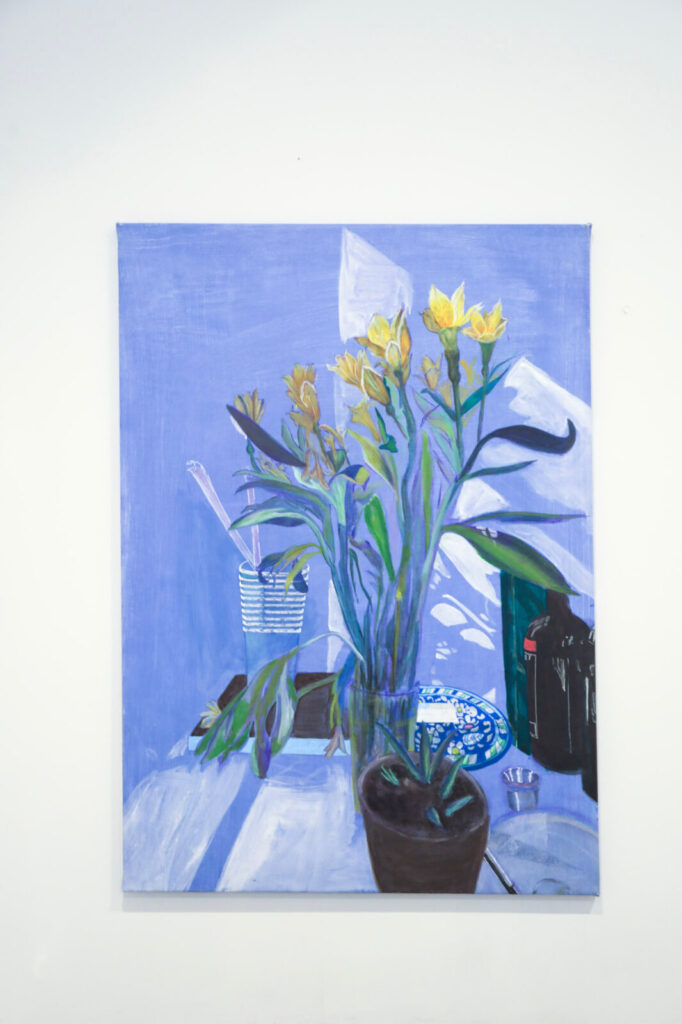
It’s constantly evolving, but, at the moment, I’m thinking a lot about ecology and plant migration. I’ve also been thinking about plants that could serve as food sources. For example, I was thinking about hibiscus plants, because there’s this drink from the Caribbean called “sorrel” that’s made from it—these plants can be interesting symbols for resilience or home. People can take plants from other places and replant them in new locations, which is something I witnessed a lot. One of my great-grandmothers immigrated from Trinidad, and she had this very large garden, and would plant different things. Sometimes she would take plants back from the island. In this way, plants can allow other people to create homes or similar environments in places where they didn’t once exist.
How do you determine which medium to prioritize for a specific project?
When you decide to become a professional in art or journalism, your relationship with art is going to change. When you’re doing a specific project, sometimes you have a commission and will have to produce a piece for your editor. [Even] when you are creating visual art, there’s often a lot of written work or research that might go into it. When I’m thinking about creative projects that I want to produce, I’ll often keep a sketchbook, or I will also write on top of those things.
I am constantly writing in the Notes app on my phone or on my computer to brainstorm ideas. So, I think that for me, writing is always integrated at different stages. But at the moment, I haven’t been making very many creative writing projects or personal essays. As I’ve gotten older, I’ve increasingly put journalism in an entirely different category than creative writing, because I feel like the process of creative writing is a lot more analogous to producing a painting. Even if you eventually publish it, or even if you eventually show the painting, there’s not the same degree of editing or working with an editor unless you’re writing for The New Yorker, and it’s a fiction story.
A lot of your written work covers underrepresentation. How does making work of your own that contends with racial themes help you to combat or better understand its impact?
It’s an interesting time for a lot of artists of color. Following 2020 and the death of George Floyd, there were a lot of reckonings with racial issues in this country. I think that when I was in college, there was also a lot of reckoning regarding gender, because the MeToo movement was very much alive and well. So, at the time when I began to start writing professionally, these were very hot-button issues; I also felt very passionate about them and their importance. I wanted to give voice to artists who might not have received so much recognition in the past.
However, I think that as I’ve progressed and moved forward in my career, I have begun to ask more questions about what that means in terms of representation—what types of work specifically are being highlighted by specific artists. If someone identifies as a woman, or as nonbinary or nonconforming, I don’t always think that the onus should be on them to make work about gender. Similarly, if you’re a black, I don’t think you should necessarily have to make work about black identity all the time.
This also speaks to a shift I’m undergoing in my own practice, focusing a little bit more on objects and consumerism and technology. There are a lot of other things that I’ve been thinking about that extend beyond race or gender. It’s very apparent to me that there are so many other pressing issues that are very important to talk about. Art and writing are very important for thinking about those things. There was a Substack I read by Elif Batuman talking about James Baldwin and how important of a role he played in terms of talking about politics and race in his art.
You don’t necessarily need artists to be out in the streets all of the time in order to be making change. But, at the same time, I do personally feel like an inflection point is being reached, and that it is important for artists to be more materially engaged with their communities. That’s something I’m still trying to figure out how to do. I am an educator too, so I feel like a lot of important work can be done in terms of: What are you teaching children in classrooms? Even teaching them things like reading skills is important because a lot of the kids who I work with, Gen Alpha and older Gen Z, their relationship to the internet is so different from the relationship I had to the internet growing up, so different from my mom’s relationship with it. Making sure that kids have the skills to cognate is another way of being politically engaged.

What other artists express politics through their work in a way that inspires you?
Joan Semel, the painter. She’s in her 80s or 90s now, but she makes a lot of self portraits of her aging body, in a way that is very political when we’re living in a culture that is very much focused on youth. It is inspiring because she’s challenging what a female nude should look like. Another painter who I really like is Jenny Saville. She also has worked a lot with the female body, and depicted it in ways that are not what you would be used to seeing, and then combining the figure with more abstract mark making. I think that both of those painters, to me, are making almost political statements with their work in a way that doesn’t feel so harsh and abrupt. I think that I’m definitely moving in a direction where I would like to focus a lot more on technique and color and composition instead of just slapping some political word or statement onto something. There was a time when a lot of left-leaning artists were making a bunch of work about Trump, and I think that people are allowed to express their emotions and to react to things. But, I also think that there is something to be said about craft and technique. Attention to detail is important too.
Has your perspective on gender and racial identity in art shifted over time?
Definitely. I’m now in a place where I think that nothing is monolithic. People are going to have different ways of expressing their gender and racial identities. I think that by getting older and coming more into myself in terms of an artist, I know what I like.
Sometimes what you see a lot in terms of conservative ideology is this hyper-focus on craft and this idea that things need to be super representational. Conservatives often like law, the Renaissance or the classics, like Plato and Aristotle. That’s not the only way that these thinkers or artists can be used—I love all of those things too. I think that there is something really good about paying very close and careful attention to executing something, and I don’t think that that should only be adopted by the right.
Another thing I’ve been thinking about a lot is that emotion does serve a place in art. People should be able to act in a way that is emotional, because those things often get labeled as female or anti-intellectual. There’s a way to lean into aesthetics that are more traditionally seen as feminine, while also being able to express ideas that are very complicated and nuanced.
Oftentimes, when you’re talking to academics, specifically in the art world, or just in academia full stop, there is this “thumbing the nose” at popular culture, which I think is something that is toxic and should be reckoned with. I do think that there is a time and a place for intellectualizing things, but I think that sometimes, class and other facets compound these issues of race and gender, when there’s almost an unwillingness to look at things from different perspectives.
Which artwork or written piece are you most proud of?
A painting called “Social Mobility” that was in the Brooklyn Museum. I was thinking a lot about composition and color, and different books and literature, and how that interacts with family histories, and also plants and household objects.
In terms of writing, I wish I had a piece that I was really proud of. You really have to say to yourself as a young writer, “I am going to take time to do this and maybe not pitch it, just hold on to it and fine-tune it.” Sometimes that is a little bit more difficult to do with writing, especially when you also have an artistic practice. I think you get to a point where you have to choose where you want to direct your focus. As of late, I’ve increasingly veered towards the visual, with little pops of text.