
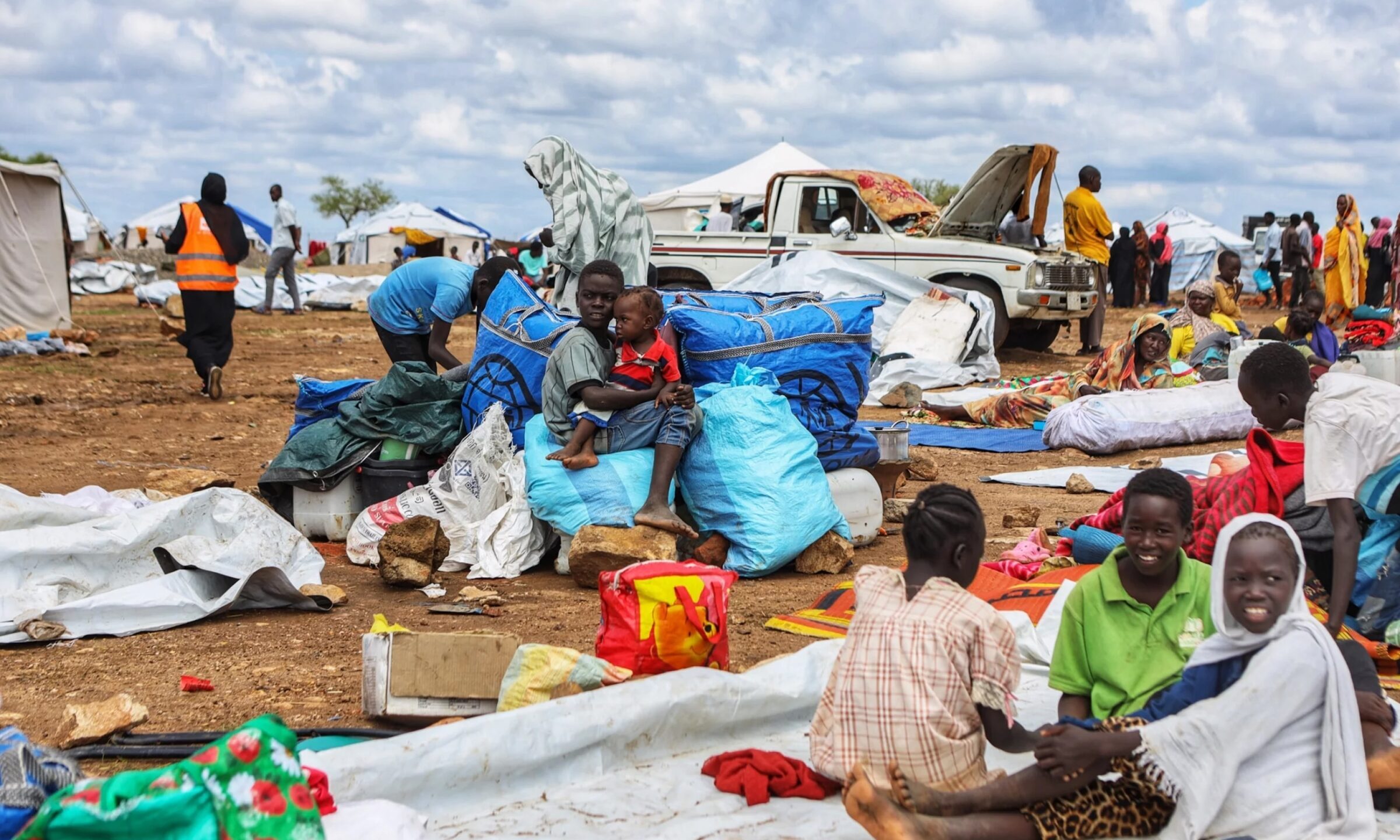
“I met so many mums who just feel like they are watching their children starve and die. There’s nothing that they can do to help, and they feel forgotten,” said Meghan Greenhalgh, Director of International Programs at the International Medical Corps, who recently visited Sudan to report on the war.
The conflict, which has left more than 30 million people in need of relief assistance, is now one of the largest humanitarian crises in the world. It is a stark reminder of the tragedies civilians face, conflicts refugees flee, and the need for international organizations—systems created precisely for moments like this.
It is also a sign of changing times: diminished Western engagement and rising influence of middle powers.
El Fasher, The Last Battle of the Genocide
Blood on the sand is visible in satellite images of El Fasher, captured by the Rapid Support Forces (RSF) —a paramilitary group and one of the warring parties—on October 26, 2025. The seizure ended an 18-month-long siege of the city, marking a turning point in the war. As David Simon, a Yale Professor and Director of the Genocide Studies Program, put it, “It was the last battle of the genocide.”
Multiple international organizations, including Refugees International and the Sudan Rights Watch Network—and, as of January this year, the U.S. government—have described the RSF’s actions as genocide. “The RSF has been specifically persecuting the non-Arab Fur, Zaghawa, and Masalit ethnicities in western Sudan,” Simon explained. In the outskirts of El Fasher, the RSF burned only Zaghawa households— an action that fits the definition of a genocide—the deliberate, systematic destruction of an ethnic group.
Nathaniel Raymond, Director of the Yale Humanitarian Lab, which uses satellite images to monitor the conflict, said that as early as March 2025, his team was able to “raise warnings that [the genocide] was underway.” Using thermal signatures, they observed that in four tribal villages supplying El Fasher, the RSF were burning crops intended to feed the city.
In an interview with The Politic, Declan Walsh, a Pulitzer-Prize-winning New York Times Africa correspondent, noted that, “The RSF has been accused of the most serious crimes.” He mentioned numerous reports of sexual violence, rape, and massacres, many of which were ethnically targeted killings.
The Lesser of Two Evils
The RSF grew out of a paramilitary group, the Janjaweed, a title they adopted for themselves, which literally translates to “Devils on Horseback.” From 2003 to 2005, they committed genocide against Darfur’s Fur, Zaghawa, and Masalit ethnicities as called out by President George W. Bush, the U.S. Congress, and the International Criminal Court. Now, “The RSF are using the civil war to complete the genocide against the non-Arab populations that they began twenty years ago,” Raymond said.
While the Sudanese Armed Forces (SAF) are often characterized as the “lesser of two evils,” Walsh, the Times correspondent, warned that the “Sudanese military has been accused of sexual assault, rape, and extrajudicial executions.” Most of the war crimes attributed to the SAF, however, involve indiscriminate bombings of civilians.
Munira Elbashir, a Sudanese Yale student, pointed out that “The revolution in 2019 was against the SAF, the military that brutally repressed the Sudanese people for decades.” Omar El-Bashir ruled Sudan until 2019, when civilian protests led to the overthrow of his regime.
After months of civil unrest and violent repression, “the military and security apparatus removed Bashir from office,” said Alden Young, a Yale History Professor specializing in Sudan. After months of demonstrations as well as violent massacres, in 2019, the military and protest leaders reached an agreement. “The civilian Prime Minister Abdullah Hamdok was supposed to rule for two years, until civilians would take over the Sovereign Council and prepare for elections,” Young said.
But the transition was fragile. “We often think that democratic transition will happen sort of automatically,” Young commented. “But Sudan has been sanctioned since the 1990s, and those countries need significant support in transitioning out of sanctioned regimes. I think in 2018 and 2019 the United States needed to rally financial and other types of support to the Sudanese state if democratic transition was going to be made possible.”
By that point, the RSF had been incorporated into the army as an autonomous unit. In 2021, the RSF and SAF jointly carried out a coup. In 2022, the civilian Prime Minister Hamdok resigned. “The military was governing by itself, without civilian participation.” By 2023, the two military groups were negotiating a plan for the future form of government. “The sticking point became the integration of the RSF and the SAF into a single force,” Young added.
Amid the power struggle, fighting broke out in Khartoum. “We don’t know exactly who shot who first,” said Young. Since then, the RSF and SAF have been at war with each other, with the SAF capturing the capital, Khartoum, and the RSF pushing into Western Kordofan and Darfur.
A Humanitarian Tragedy
The conflict in Sudan has contributed to a humanitarian crisis of staggering proportions: half of Sudan’s population—30 million—urgenty require aid.
“Food is a massive need,” Greenhalgh said. “The population is starving.” Even compared to other humanitarian crises, the rates of moderate acute malnutrition and severe acute malnutrition in young children under the age of 5 are exceptionally high. In El Fasher and Kadugli, the conflict-affected regions, food insecurity and malnutrition are at the highest levels of need, according to the World Food Programme, UNICEF, and the Food and Agriculture Organization of the United Nations.
Conditions in El Fasher are particularly dire. New York Times journalist Declan Walsh recalled his conversation with Dr. Omer Selik, a doctor working in the last hospital in Darfur. Walsh detailed, “He said that food supplies had effectively run out, and people were being reduced to eating animal feed. Anyone who attempted to smuggle food or medicine into the city was being stopped, harassed, or killed by the fighters who surrounded the city.”
A few days after that conversation, Doctor Selik was a victim of a mass attack. “He went to attend prayers at a mosque near his house,” Walsh recalled, “And there was a drone strike. About 75 people were killed, including him.”
Access to safe water is limited in most regions in Darfur. Greenhalgh reported, “I heard stories of people who were trying to truck in water. A lot of those drivers were shot, and then the water was looted.”
Commenting on the healthcare system, she said, “The healthcare system was barely functioning for a long time. The health facilities were all looted as part of that initial stage of the conflict, and probably for twelve months, humanitarian partners did struggle to get access.”
The True Cost of Aid Cuts
Even as needs soar, global institutions are losing influence and power. Still, Sudan underscores their importance and the catastrophic impact of withdrawing support.
“Sudan became the largest UN operation because we had to respond to the largest humanitarian crisis in the world, in terms of people in need, the increased food insecurity, and the almost total disruption of services across the country,” said Luca Renda, the United Nations Development Programme (UNDP) Resident Representative in Sudan. He further elaborated that the United Nations High Commissioner for Refugees is “assisting both refugees and internally displaced people with shelter, health care, psychosocial support, protection, cash assistance and non-food items, as the security situation allows.”
The World Food Programme and UNICEF are delivering nutrition support where accessible. The UNDP administers grants for HIV, TB, and malaria programs, while the International Medical Corps runs health and nutrition services.
Greenhalgh warned that hunger will have long-term consequences, like stunting, for younger children. Still, the Sudanese population is not at a stage where the consequences will be irreversible.
“Closing down USAID and freezing vast amounts of American aid has made the capabilities of humanitarian agencies even harder,” said Declan Walsh. “In Sudan alone, at one point, 80 percent of all emergency feeding programs were affected,” Raymond asserted.
Confusion over which funds had been cut proved deadly. “Kids have literally died because of the confusion about what money has been cut and what money hasn’t.” In areas under integrated phase classification level five, the most severe level of food insecurity, any disruption is catastrophic. “It takes about two weeks for people to die, especially when they’re already weak,” Raymond commented.
Renda confirmed that UNDP lost $35 million in funding, part of a broader drop in contributions from the U.S. and other Western countries. Programs for unaccompanied children—designed to prevent trafficking—were also affected.
Greenhalgh underscored the widespread use of sexual violence. “In the last twelve months, the IMC has done a lot of work on mental health and gender based violence programming,” she said. For many women fleeing El Fasher, “the violence has been a really horrific thing, especially in cases where it was mass gang rape,…they are very much struggling to recover…because you can’t.”
As Nicholas Kristof reported, clinics in South Sudan helping Sudanese rape survivors have closed. While nonprofits temporarily reopened a facility, “there is immense uncertainty…about whether they will be paid for their work and whether such operations can continue.”
Fourteen Million Refugees
The conflict has led to the largest displacement in modern history. As of October 2025, 14 million people had to flee their homes, with 11 million people internally displaced within the country and three million refugees outside Sudan, mainly in Egypt, South Sudan, and Chad, and some in Ethiopia, Libya, and Uganda. Five million people left Khartoum, the capital that previously housed nine million.
“In Darfur, camps and all the services were set up for 50,000 people, and we’ve seen that number then come up to around 125,000; in one of the camps, it jumped to 220,000 people,” said Greenhalgh. She explained that the high demand for shelter has led to the construction of more haphazard sites, which are neither fully adequate nor safe. It also places an increased burden on essential services, including the water network, health delivery, and nutrition programming.
To support internally displaced people, the UNDP has deployed mobile health clinics and expanded micro-lending programs, particularly for women’s associations.
Many families have been displaced several times. Elbashir described how her relatives, now in Uganda, moved four times—from Khartoum, to Kosti, to the South Sudan border, to Juba, and then to Uganda.
Since November, however, more people have been returning, as some areas have fallen under the control of the army and the conflict has begun to stabilize there. “Two million people have gone back, first to Gezira, and now to Khartoum,” said Renda, “And this is another big issue, because a humanitarian system is needed for a short time, but then you need to come up with more investments like service rehabilitation and access to livelihoods, and de-mining.”
Sudan, A Proxy War
“The predominating way that the war is referred to is a civil war, but a lot of Sudanese scholars and activists take issue with this framing, because it grossly understates the level of external intervention in Sudan,” Elbashir told The Politic. Numerous other countries are involved in the war, including Egypt, Turkey, Iran, Russia, Chad, Kenya, South Sudan, Saudi Arabia, and most importantly, the United Arab Emirates.
Egypt, Turkey, and Iran have been providing direct support to the SAF. Egypt has increased its support for the SAF due to its interest in ensuring that its neighbor is not run by leaders hostile to Cairo. Regarding Iran, Walsh explained, “It’s unclear whether Iran supplies drones purely on a commercial basis, as the Sudanese military claims, or whether there’s an element of the Iranian state providing support.”
Russia’s Wagner group, a state-funded paramilitary group, has aided the RSF, and Russia is developing ties with the SAF, as Moscow seeks Red Sea access and mining opportunities. Regional powers have also become engulfed in the war: Chad hosts refugees and enables the RSF to smuggle weapons into Sudan, and formally neutral Kenya has allowed for the RSF to organize on its territory.
UAE, the Foreign Enabler
Yet, it is the Emirates that is the most consequential foreign actor. “Without the UAE’s military and intelligence support, the war would not have continued as the RSF would not have been a competitive fighting force,” said Nathaniel Raymond, head of the Yale Humanitarian Lab.
When explaining the transformational impact of the UAE’s support on the RSF, he said, “Their technological capacity has gone from using Enfield Rifles, AK-47’s, and riding on horseback twenty years ago, to having increasingly sophisticated drone technology, artillery communications, electronic intelligence capabilities, and advanced forms of command and control through encrypted communication.”
Just before the seizure of El Fasher, the RSF received an increase in supplies from the UAE. “So it’s reasonable to assume that that made at least some difference” commented John McDermott, The Economist’s Chief Africa Correspondent.
No one is certain what the main driver of the UAE’s involvement is. Historian Alden Young pointed to a personal relationship between the head of the RSF, Hemedti, and powerful members of the royal family. “Also, the Emiratis do not wish to see the SAF become the sole hegemonic power in Sudan, because they believe that they are still tied, however loosely, to the Muslim Brotherhood. And Emirati policy is to contain and defeat the Muslim Brotherhood throughout the region.”
Young also highlighted the UAE’s economic self-interest: the SAF and RSF are buying gold from the UAE, and Sudan’s middle and upper middle class has increasingly moved its banking to the UAE.
Moreover, due to migration, labor is cheaper. “A lot of my contacts tell me the price of professional labor keeps plummeting, in Doha and Dubai and other cities across the Gulf, ” explained Young, “Now, the Sudanese are working at much lower wages.”
Professor David Simon highlighted the UAE’s transactional agenda: “The UAE wants greater access to African resources and influence over the countries that control those resources.” He continued that this comes as the United States pulls back, “closing down embassies, shuttering U.S. aid, and leaving space for actors like the UAE to provide security or arms in return for access.”
The UAE’s support is now so crucial that many believe the RSF could not fight without it. “Many Sudanese analysts would say that if the Emiratis wanted to stop the war tomorrow, they probably could,” said Declan Walsh.
Yet, “Until recently, many Western countries have been accused of being reluctant to put pressure on the Emirates because of their reliance on investment,” Walsh observed. Reflecting on U.S. involvement, he said, “It sees the Emirates as a major security partner in the region against Iran and in relation to Israel.”
A Different Decade
The world responded very differently to the crisis in Sudan two decades ago—“in the 2000s, the international community could take some credit for stopping a genocide,” Simon concluded. The 2000s saw coordinated international pressure, ICC warrants, and successful efforts to isolate the Sudanese government.
Simon recalled that, before the 2008 Beijing Olympics, civil society groups pressured anyone associated with the Games, threatening to call them the “Genocide Olympics.” Ultimately, China did not obstruct the UN in the Security Council and distanced itself from the Sudanese government. In effect, the Janjaweed were sidelined, and the Sudanese government was weakened.
Simon believes that the international community could now do something similar, this time putting pressure on the UAE. “If countries got together and said, ‘Hey, UAE, you’d better show you’re opposed to genocide or we won’t do business with you,’ ” he said.
Because the UAE is economically powerful but reputation-dependent, Simon argued, targeted pressure—boycotts affecting sports partnerships, for example—could be effective. Such action, however, must come from civil society.
In the 2000s, civil society was significantly more concerned about the crisis in Sudan and involved in addressing it. A total of 190 religious and human rights organizations came together to create the Save Darfur Coalition, organizing mass protests and concerts to pressure policymakers. Famously, George Clooney visited Darfur to bring international attention to the genocide at the time. Eventually, an arms embargo was imposed, and African Union peacekeepers were sent to the region.
Simon argued that, comparatively, the international community has done little in the current conflict. “They have issued an arms embargo with zero enforcement, had no meaningful Security Council discussion, and haven’t targeted the UAE, giving it a total free hand to run weapons,” he said.
The African Union, too, has played a comparatively limited role., despite its anti-coup policies and institutions that were instrumental in past Sudanese conflicts. “This time, they’ve done very, very little,” McDermott commented.
While historian Alden Young expressed skepticism over whether the UAE alone could make the war stop, he acknowledged that “Political pressure and boycotts that hurt the UAE’s reputation might force it to engage constructively in a peace plan.” He added, “One of the problems a few years ago was that the UAE was absent from the Jeddah and other peace talks.”
The Road Ahead
The prospects for ending the conflict remain uncertain. Any arrangement would require engagement of the SAF, RSF, UAE, Gulf states, and African countries.
So far, a group consisting of the U.S., UAE, Egypt, and Saudi Arabia have come together as “the Quad” to discuss the future of the conflict. They met in September 2025 and released a statement on “Restoring Peace and Security in Sudan”.
“Because it includes Egypt, which is more closely aligned with the Sudanese military, and the Emirates, it’s a little bit like the foxes being in the hen house,” Declan Walsh commented on the group.
Alden Young expressed that both sides may be more willing to negotiate after the SAF capture of Khartoum and the RSF capture of El Fasher, which happened in recent weeks.
John McDermott cautioned that RSF has national ambitions, but agreed that the taking of El Fasher does not show that they’ve given up in negotiations. Commenting on the likelihood of RSF seeking negotiations, he said, “It depends chiefly whether it feels that the costs of stopping the war are greater than the benefits—costs that come not only on the battlefield, but also in its relationships with the conflict’s sponsors.”
Young raised the potential power of sanctions: “If they do multilateral sanctions and demands on the two actors, I think it is possible that we could get to a peace agreement.”
“Any peace agreement,” as David Simon pointed out, “is going to require some sort of security guarantees.” He went on, “It depends on what the proposed end state is. Is it the return of surviving Masalit, Zaghawa, and Fur back to their original homesteads, or at least to the cities of Darfur? Is it some sort of protection or new construction for them somewhere?” McDermott added other unknowns: “Would it be the SAF that takes over entirely? Would it be a civilian-led government? What happens to Darfur?”
Regardless, any post-conflict context will require money, the commitment of all countries involved, and the work of international institutions. The work, that is, of rebuilding, de-mining, post-conflict reconciliation, and addressing the humanitarian needs of the Sudanese people—the population that will come back and those who were forced to stay and live through the horrific war and its brutal consequences.
***
The resilience of the Sudanese people coupled with the international community finally mobilizing after the wake up call of the siege of El Fasher, provides a renewed sense of hope.
Speaking about the women, who fled El Fasher and are now in Tawilan refugee camps, UN Under-Secretary-General for Humanitarian Affairs Tom Fletcher said, “For now, they found a place of hope and refuge… but they don’t know how long it will last.”
How long it lasts, he emphasized, ultimately depends on the international community: “It depends on the world being ready to listen and to offer them the protection… that we should have given them before.”