
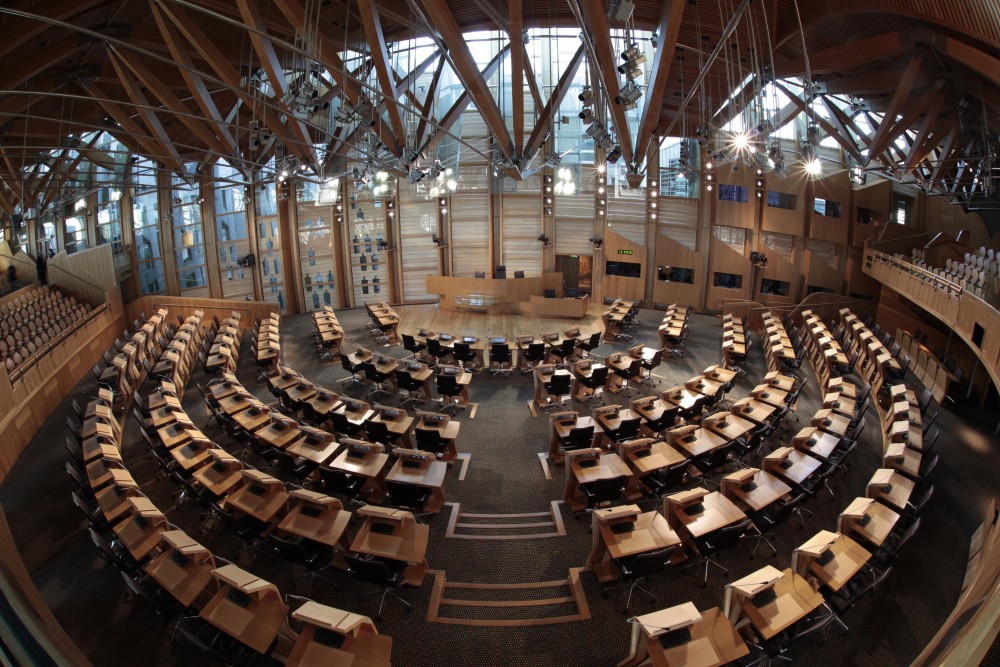
Photo: The main hall of the Scottish Parliament building outside Edinburgh, Scotland. Sandy Brown Acoustics.
In March 2026, at the Scottish Cup quarter-final football match between Glaswegian cross-town archrivals Celtic and Rangers FC, a violent pitch invasion transpired. Following the Celtic victory, fans of both teams stormed the field, and pyrotechnics were set off. It was chaos; a member of Celtic’s staff was assaulted, and a Rangers fan almost reached Celtic players before being tackled by police. The event ultimately resulted in several injuries and arrests.
Sectarian clashes between the primarily Catholic-supported Celtic and the Protestant-supported Rangers are a long-running trend, despite denunciations of violence by both the Scottish government and a majority of fans of both teams. Concerns over fan safety, along with disputes over ticket allocation, led to a several-year ban on away fans at matches between the two teams until the fixture in March 2026. While Rangers FC loyalists are generally pro-British and support Northern Ireland unionists, the same cannot be said for fans of their rivals. Andrew Skinner, an activist and member of the pro-union Scotland in Union advocacy group, said, “I live in an area in the east end of Glasgow, which could be called a nationalist, sort of Republican area. At the local Celtic football matches, I get to see more anti-Britishness, the pro-Irish Republican Army (IRA) songs. That Irish influence is certainly still there.”

Photo: A Glasgow Rangers fan attempts to block a police officer as they work to restore order after the chaotic aftermath of the Celtic v. Rangers match, Ibrox Stadium, Glasgow, Scotland. FOX Sports.
These events are situated against the backdrop of Scotland’s upcoming parliamentary election on May 7th, 2026. While over the past few decades, Scotland has enjoyed a significant level of autonomy, including its own parliament, significant political forces in Scotland advocate for full independence. The First Minister of Scotland, John Swinney, who leads a minority government in the Scottish parliament under the auspices of the pro-independence Scottish National Party (SNP), has stated that his party winning a majority in the tightly contested election would give him a mandate to demand a second independence referendum. This line of thinking stems from the climate that led to the failed 2014 independence referendum, which was arranged after the SNP won an outright majority in the 2011 Scottish elections. The election will decide not only the regional governance of Scotland but also the future of the increasingly unstable United Kingdom as a whole.
Many find it easy to compare Northern Ireland and Scotland because both are semi-autonomous regions within the U.K., containing popular nationalist breakaway movements. However, sectarianism plays a much smaller role in attitudes around unionism or independence in Scotland. In Northern Ireland, Catholics generally support unification with the Republic of Ireland while Protestants overwhelmingly support continued union with Great Britain. Despite Northern Ireland maintaining a plurality in support for continued union with Britain, calls for reunification with Ireland have morphed into deadly conflicts and insurgent activity, leading to the deaths of thousands during the decades-long irregular conflict known as “The Troubles” during the mid-to-late 20th century. This level of instability is foreign to Scotland, whose debate over independence lacks the same intensity as that across the North Channel.
***
Beginning with its establishment in the 9th century, apart from intermittent periods of English overlordship, Scotland remained independent of the Kingdom of England. This trend devolved in 1603 when the country entered into a personal union with England under King James VI. While both countries had the same head of state, they retained their own respective parliaments. Despite his attempts to integrate the two kingdoms, it would take another century for Scotland and England to fully unify.
Against the wishes of a majority of the general population, the Scottish parliament, along with its English counterparts, passed legislation uniting the two nations and their parliaments into a single state and legislature under the 1707 Acts of Union.
Inside contemporary Scotland, opinions are mixed on the relationship between England and Scotland post-unification and on the role Scots played inside the British Empire. While nationalist rhetoric often portrays Scotland’s historical relationship with England as one of subjecthood or even colonial status, this viewpoint has been challenged by both academics and the SNP leadership.
A 2025 YouGov poll found that 40% of Scots believed that Scotland was a subject of the British Empire, while only 29% believed that it was a partner. According to the poll, pro-independence voters in the 2014 referendum were much more likely to view Scotland’s role as akin to a subject, in contrast to unionist supporters, a plurality of whom believe Scotland was England’s partner. Despite the pervasiveness of the idea of subjecthood, most experts generally reject the claim that Scotland’s relationship was similar to that of Ireland and other imperial possessions. Dr. Ewen Cameron, a professor in History, Classics, and Archeology at the University of Edinburgh, noted that, while nationalist, anti-colonial, and anti-English narratives are prevalent online, “The situation was a bit more complex. Scottish elites and non-elites were both very successful in exploiting the structures of the empire… Some [Scottish] people made huge sums of money from the exploitation of enslaved peoples in the Caribbean, and there was a lot of money flowing back to Scotland during the height of the empire.” He continued, “Some Scots even saw the Empire as an arena in which to perform Scottishness.”
Andrew Skinner, the pro-unionist organizer, agreed: “Rather than being a colony, Scotland was the colonizer.” Alexander Elliards also disagrees with the nationalist interpretation of Scotland as a colony. Despite his role as a journalist at the pro-independence Scottish publication The National, he shared the idea that Scotland was one of the driving forces behind colonization. “Some parts of the empire were only Scots, like Myanmar, St. Kitts and Nevis, and St Vincent, so that argument is nonsense.”
Henry Phelan, social media manager for the student-led Scottish Independence Society at the University of St. Andrews, concurs with the assessment that Scotland was not a colonial subject of the British Empire, even though he rejects unionism. “Scotland was an active participant and beneficiary of the British Empire,” he said. “It’s unfair to say that Scotland was a victim or subject.”
Regardless of Scotland’s inability to claim the same anti-colonial struggle championed by its neighbor, Ireland, there are still several reasons why many Scots, especially the youth, feel resentment towards Westminster. Rory Young, the president of the University of Edinburgh’s pro-independence YES Society, noted how youth “…care passionately about issues such as foreign policy and the cost of living, and are aware that independence could allow Scotland to be a bigger player in world affairs, promoting our humanitarian voice, as well as returning to the E.U.” He continued, “Many Scottish students are keen to have full access to the E.U. for work and study.”
***
Initially, in the 20th century, the majority of Scots were opposed to European integration. However, after Margaret Thatcher’s deindustrialization policies in the late 90s alienated working-class Scots, many became more supportive of the E.U. due to its support for negatively affected areas. Cameron noted how “Scotland did quite well out of the European Structural Funds’ post-industrial projects [which tried to] revive areas which were blighted by industrial closure and so “revive areas which were blighted by industrial closure.” He explained, “The E.U. and its various manifestations since the 70s provided a tangible contribution to Scottish life and infrastructure.”
Even among the pro-independence Scots who, like unionists, might reject the idea that England historically dominated Scotland, Westminster’s more recent actions have been perceived as domineering. “Scotland voted heavily against Brexit, but was dragged out of the E.U. against their will,” said Phelan. “Seeing the whole Brexit process, how much of a mess it was, and how Scotland never voted for it in the first place, never really sat right with me.”
This view of a domineering England goes back further than Brexit. Alexander Elliards believes many people see Scotland as controlled by England because of how the British government handled North Sea oil in the 1980s. “The U.K. government at the time panicked, because, if all of that resource [oil] was then grouped under Scottish GDP and Scottish economic forecast…Scotland would be the richest part of the country by a million miles,” Elliards said.
To avoid this, the Thatcher government decided to create a new economic zone for the offshore oil that would not be counted towards Scotland’s economy and would fall under the auspices of the U.K as a whole. To Phelan, “Thatcher used Scotland’s oil to support the wider U.K. economy, while simultaneously neglecting the interests of Scottish people…I think that was mishandled, and that the main loser in that situation was Scotland and its economy.”

Photo: An oil platform in the North Sea, about 100 miles east of Aberdeen, Scotland. Andy Buchanan / AFP Photo.
***
Outside nationally administered spheres such as energy and defense, the Scottish government has a high degree of autonomy under Westminster’s devolution policy, giving Scots a snapshot into how a potential independent Scottish government could be run. Their authority extends across a wide range of policy realms, including healthcare, education, policing, housing, and several forms of taxation. Opinions on the performance of Scotland’s devolved government, which has been led by the SNP for almost two decades, greatly impact people’s support for independence, with positive views of Scotland’s governance increasing confidence in the viability of an independent Scotland. Phelan said he chose to get more involved in independence activism because of the effectiveness and rhetoric of the SNP-led Scottish government.
Conversely, Andrew Skinner disagrees with the claim that the party has been able to materially deliver on promises of effective governance. He claimed that despite “Scotland [having] one of the most powerful devolved governments in the world, if something is failing, whether that sector be NHS, education, or something similar, they ensure that the blame passes to Westminster or London.” However, if their wish for an independent Scotland is realized, the SNP will bear the brunt of responsibility for all of Scotland’s successes and failures.
The decisive elections regarding the future of Scottish independence (or lack thereof) may not be the devolved elections scheduled for May, but rather the U.K. general elections that will be held by August 2029, as the ultimate authority to grant a referendum lies not with the Scottish government but with Westminster.
Reform U.K., a right-wing anti-immigration party led by Nigel Farage, one of the leaders of the Brexit campaign, has surged to first place in the U.K.-wide polls and has also garnered significant support in Scotland. While Dr. Bennie notes that—despite many believing that “Scotland would never support a party like Reform UK”—it appears that the current hard-right of British politics is garnering more support than earlier fringe iterations, such as the pro-Brexit UKIP (United Kingdom Independence Party) and Brexit Party, which had never won any seats in the Scottish parliament. She continued, “The rise of this party is obviously having an effect in Scotland, with about 18% support for Reform UK.” Despite the party’s unexpected popularity in traditionally left-of-center Scotland, a vast majority of Scots still oppose it, and Elliards believes a premiership under Reform U.K. leader Nigel Farage would likely embolden the independence movement rather than hamper it.

Photo: Nigel Farage, leader of Reform UK party, speaks after a successful performance in local elections, Romford, England. Dan Kitwood / Getty Images.
Citing the rhetoric that many right-of-center English politicians utilize when referencing Scotland, he said: “From Reform, [and from] a lot of the Conservatives as well, we hear, ‘Oh, Scotland’s a subsidy junkie. All the U.K. does is pay your way. We could definitely go without Scotland.’” A demeaning and dismissive response to the independence movement from a possible Reform or Reform-Conservative government, therefore, may be the force that garners enough support for Scotland to become independent. Rory Young from the Edinburgh YES Society commented on the ideological gap between the Scottish and U.K. governments: “It will only widen if Reform is elected. We attempt initiatives, and sometimes London blocks them, which is frustrating, and it fuels the desire for independence because we feel it is becoming increasingly difficult to cooperate within the constraints of devolution.” Despite the broad swathes of power that have been afforded to Scotland under Westminster’s commitment to devolution, a left-wing agenda in Edinburgh may not be able to coexist with the entirely different direction that Farage aims to take Britain.
Skinner shared what he viewed as a significant contrast between anti-unionist movements in Scotland and Northern Ireland, sharing that the movement in Ireland is “…about uniting Ireland, whereas here in Scotland, [nationalists] are looking to divide our island with England.”
The Scottish independence movement is one of contrasts, that of a state wishing to pursue separation from the U.K. as a means of pursuing unity with the E.U., and that of one of the former core regions and benefactors of an empire now seeking to break up its last vestiges. Despite the differences between the two nations, Young noted that pro-independence activists “draw inspiration from successful nations such as Ireland. Dublin participates regularly in E.U. and international affairs; we believe that we can follow and do the same.” Young paused before adding, “That’s before we consider the other 60-plus countries that left Britain and haven’t looked back.”