
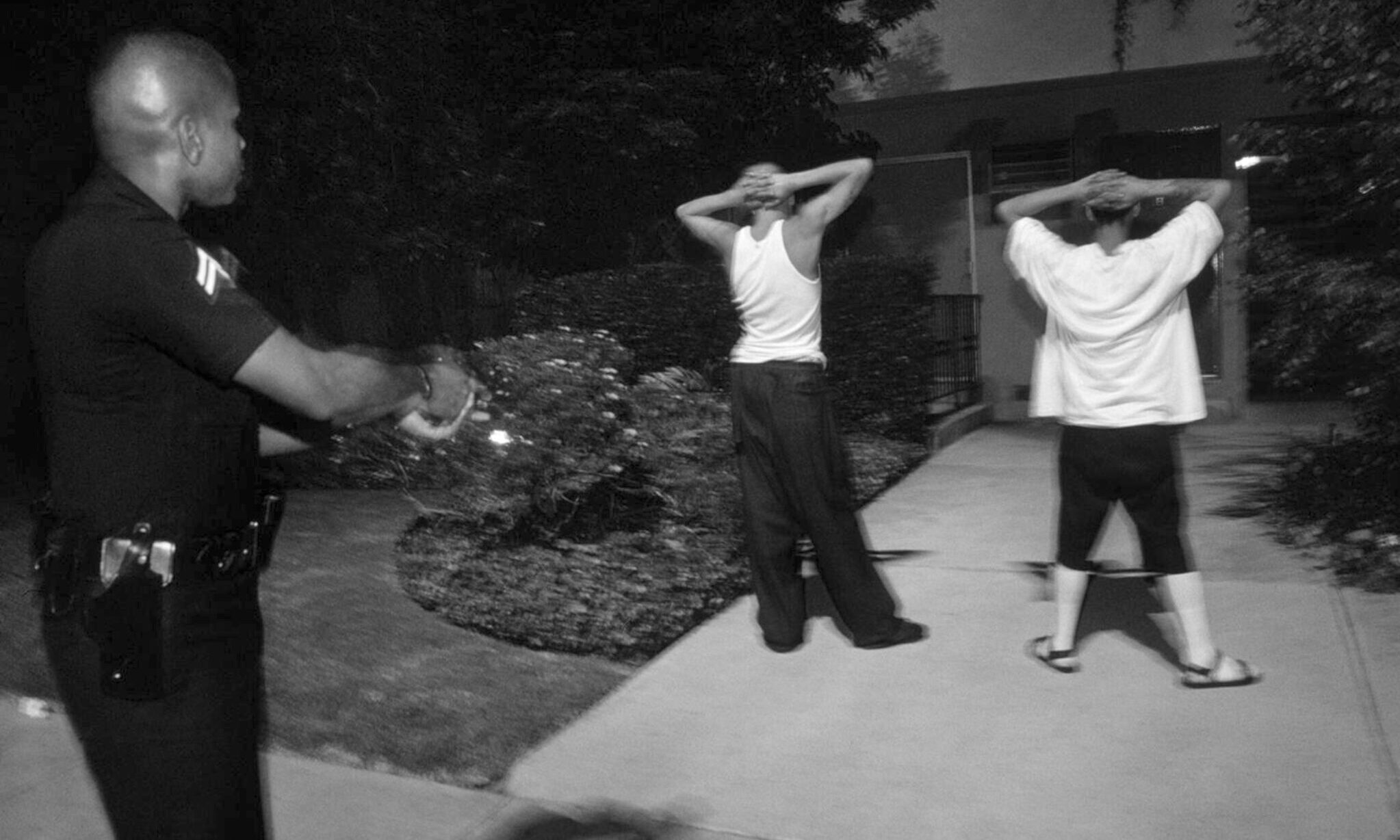
LAPD Officer holds car theft suspects at gunpoint, later identified as gang members, Los Angeles, 1994. Joseph Rodríguez, LAPD 1994.
Orbelina shared her story at considerable personal risk. Some names and identifying details have been changed to protect her and her family’s safety.
Orbelina’s interview was conducted in Spanish and translated.
April, 1985. San Salvador. Orbelina, seventeen, stood at the airport gate. Her mother held her face in her hands for the last time. She said:
“If you look back, you’ll want to stay. I prefer 1,000 times that you live, even if I never see you again, than that you die here in the streets of El Salvador.”
Orbelina lost her mother behind a veil of tears as she walked to her plane. The air was thick with tropical humidity and the soot of a country burning. Behind her, a war raged with no end in sight. Ahead stood a city she had never seen. She kept her eyes forward.
Orbelina’s voice carries the testimony of several generations. She is one of many witnesses to the trail of blood, La Sangre de Los Ángeles, leading from El Salvador to Los Angeles.
***
El Salvador’s 13-year civil war ended in 1992 with the Chapultepec Peace Accords. Fighting between the United States-backed military government and the leftist guerrilla coalition Farabundo Martí National Liberation Front (FMLN) had torn the country apart.
There were all the trappings of successful diplomacy: formal delegations, international witnesses, and the weight and pomp of ceremony. Peace accords signed in name only.
The FMLN entered “democratic” life as statesmen and law enforcement. The party of U.S.-backed oligarchs, Alianza Republicana Nacionalista (ARENA), retained its hold on the country’s institutions.
But the structural conditions that produced the war remained: extreme inequality, institutional violence, and a generation of young men with no path forward. The United Nations-backed Truth Commission documented the realities of the war, detailing massacres and disappearances of civilians carried out by U.S.-trained military units, and the organized state-sponsored murder of priests, students, and social activists by aptly titled Esquadrones de la Muerte, Death Squads.
The report listed names. It pointed to the highest levels of government and implicated both sides of the war.
But within days of its publication, the ARENA-controlled legislature passed a blanket amnesty law. No one was prosecuted. The victims received nothing: no acknowledgment, no reparations, no justice.
Orbelina’s own father was assassinated by the FMLN on June 15, 1980, Father’s Day, in front of her four half-brothers and his wife. His grave is unmarked. His killers were never named.
A hollowed-out country, El Salvador was traumatized and structurally devastated. Orbelina, like hundreds of thousands of Salvadorans, fled to America. It was an exodus of one-third of the Salvadoran population. Orbelina’s generation was forced to flee. Raised in the smoldering embers of war, they left carrying wounds that would never fully close. Most never went back.
***
This generation did not disappear. They arrived in the Pico-Union neighborhood of central Los Angeles.
Graffiti and tags popped up overnight between the alleyways of dense, low-rise apartments. Packed ten to a room were thousands of Salvadoran refugees, nearly all without immigration papers. By the 1990s, 72% of the population in Pico-Union was foreign-born, and 51.2% was under 17.
Established Mexican-American and African-American gangs had already divided the neighborhood into a battlefield. Those who ran from war found themselves re-subjugated by armed gangs and territorial violence. Except now, over 2,700 miles away from home, they had no settled community, effectively no understanding of the language, little to no education, no protection, and dwindling hope.
All quickly became victims or, in time, participants.
Through the 80s into the early 90s, at the height of the crack cocaine epidemic and amid deep cuts to social services, greater Los Angeles had more than 60 Latino street gangs. Structural economic conditions and ineffective law enforcement permitted their proliferation; soon, there were entire communities that the city decided to contain rather than support. Controlling territory block-by-block, taxing drug sales, running extortion schemes, and making entire parts of the city impassable, gangs became the de facto governing force in neighborhoods the state abandoned.
One of the most infamous gangs was Mara Salvatrucha, or MS. The name comes from two words:
Marabunta: the swarms of army ants that move through the Central American jungle, destroying everything in their path.
Salvatrucha: slang for someone who is street savvy, sharp, and alive to danger.
Together, they branded the group as built to move, survive, and consume.
Dressed in all black, MS crews patrolled through the streets just as the paramilitary forces did in El Salvador. The underlying dynamic was the same: control through fear and punishment for those who refused to submit to MS demands.
Local and federal governments ceded control over entire swaths of the second-largest city in the U.S.
Then came the Illegal Immigration Reform and Immigrant Responsibility Act of 1996, which dramatically expanded deportable offenses and stripped away judicial discretion, allowing for the mass removal of non-citizens with any criminal records. The process was straightforward, with the aim of ridding American cities of criminal elements, regardless of how long those individuals had lived in the country, whether they had families here, or whether they had any meaningful connection to the nation to which they were being deported.
Between 1998 and 2005 alone, an estimated 20,000 individuals with criminal records were deported to El Salvador. Many were children who had grown up entirely in the U.S. Most spoke little Spanish. Most had no ties to El Salvador at all. The Salvadoran government received almost no coordination or case information from U.S. authorities about who was arriving or why. The first wave, roughly 4,000 men schooled in the streets of Los Angeles, seeded the first cells of MS in San Salvador. Just as guerrilleros had recruited during the civil war, they quickly began targeting children walking from school, church, and work.
Significantly outnumbered by older gangs in American prisons, MS was forced to align with the Mexican Mafia. In exchange for protection, MS provided hitmen, paid regular quotas from their criminal proceeds, and became, in effect, a tool in the Mafia’s arsenal. They also took on the number 13, the position of M in the alphabet, as a mark of allegiance, becoming MS-13.
Even under scrutiny and crackdown, MS-13 metastasized in territory and in the reach of its small unit “cliques” across the U.S. and El Salvador. Alarmingly, the suppression itself accelerated the problem. Mass incarceration concentrated gang leadership in prison, and each wave of arrests created a need for new recruits.
Why had containment strategies that worked elsewhere consistently failed here? And what made this gang so different from the dozens of others operating in the same streets and the same conditions?
A 2021 study published in Criminal Justice Review conducted in-person interviews with 37 incarcerated MS-13 members across Los Angeles County jails. It revealed an organization held together less by profit than by solidarity. More than 80% said “clique” members cooperate, depend on each other, and expect to remain for life. Nearly 90% said they would kill and die for each other.
This loyalty is expressed violently. New members must kill or be beaten to prove allegiance. After the arrest of 56 MS-13 members in Massachusetts in January 2016, State Police Lieutenant Colonel Frank Hughes said, “In my 30 years of law enforcement, I’ve never seen a more violent gang. The violence is unspeakable.” Many attacks purposefully use machetes to enact slow, painful deaths.
Notably absent are institutional loyalties, which define organized criminal enterprises. Only 37% agreed that belonging to MS-13 beyond their immediate clique was an important part of their identity. Less than half said membership made them feel useful. Members are fiercely bound to one another, remaining surprisingly indifferent to the broad organization itself.
Steven Dudley, co-founder of InSight Crime, author of MS-13: The Making of America’s Most Notorious Gang, argues that MS-13 “is a social community first, and a criminal community second. MS-13 is a gang that had every opportunity to become a large transnational criminal organization. Never did… we have not a single international drug case connected to MS-13. That is not what they do. That’s not their core ethos.”
Dudley argues that the attraction of MS-13 was never economic, nor based on power. For young men, ejected from broken family structures, failed by schools, and invisible to institutions, it was about belonging. MS-13 filled that void.
***
Orbelina built something small and hard-won on Ridgewood Place. Two sons, one daughter. An apartment. A routine. In her mind, walking home from her three jobs cleaning homes, she held an invisible map, one that every immigrant draws of the streets that are safe and the streets that aren’t.
She survived a war. A woman alone, working, raising children, navigating a city partitioned into kingdoms she had no part in creating and no power to dissolve. She knew how to move through hostile spaces without disturbing the air.
“I came to live in this place. I didn’t know that it was full of Mara Salvatrucha. I simply just arrived there.”
***
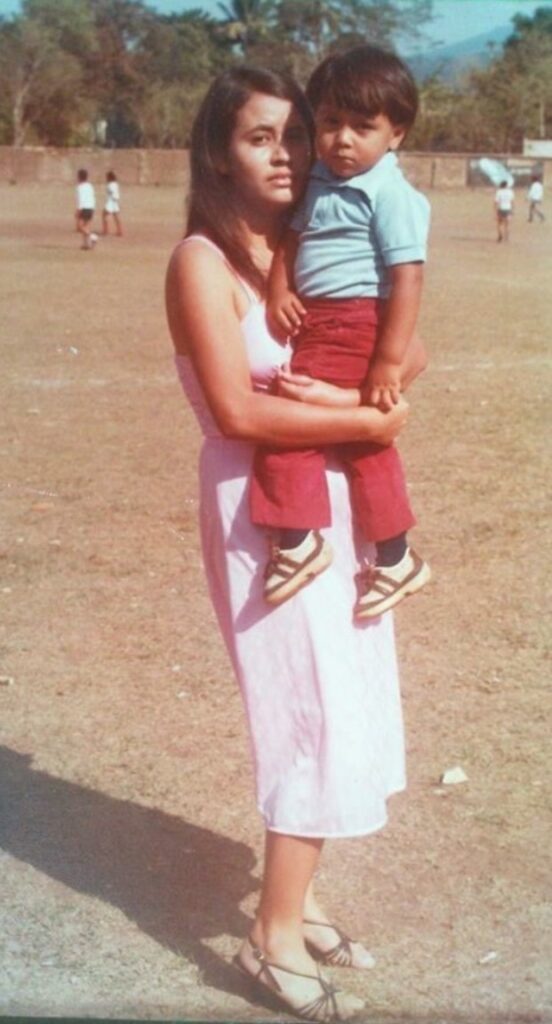
Santa Rosa, El Salvador, 1983. Photographer Unknown.
Orbelina first held Alvarito when he was five months old. Ever since, she carried her nephew through life, loving him like her own son.
By the time he was in his twenties, Alvarito was his own person. Orbelina described him as “stubborn, with a mouth that got ahead of his judgment.” He lived on La Mirada Boulevard, a few blocks north from Orbelina.
Over time, MS-13 claimed the street corner in front of his building as their office, their living room.
Alvarito snapped.
“I don’t want gangbangers in my building. Get out of here. Who are you looking for in front of my building? Here are no gangbangers. Get out!”
A few weeks later, in early November, the gang retaliated. They beat him down in front of his building, leaving him clinging to life. A note was placed in his shirt pocket, scribbled in pen and soaked in blood. You will not live to see the next Thanksgiving.
His mother packed herself and dragged her son with her, all the way across town to Martin Luther King Jr Boulevard. She thought that putting miles between her family and the threat would bring safety. Alvarito, for a time, thought the same.
On November 17th, one year later, he visited Orbelina back over on Ridgewood. It was to be a surprise.
Orbelina was walking from the bus stop when shots rang out. A child close by described what she saw: a woman at the wheel, others shooting from inside the car as it moved. Alvarito ran towards Orbelina’s house. One bullet found him, and then another as he fell.
He bled out in front of a preschool, face up on the concrete, only blocks away from Orbelina’s apartment. A few onlookers stood by. They did nothing. Whether their help would have saved him is something Orbelina has struggled with for seventeen years.
Orbelina stood far from the crime scene, unable to reach her building. It was only when a detective approached her and asked if she knew Alvarito that she knew this was not just another shooting in her neighborhood.
Alvarito died on the way to the hospital. He was twenty-three years old. The city moved around them, indifferent and ongoing.
Orbelina called Alvarito’s mother. She told her that he had been taken to the hospital, that he was hurt. She could not bring herself to say the rest, not over the phone. She called the family: they would go to his mother’s door together, stand around her when they told her, and make sure she did not fall alone.
Nobody made it there in time.
Seemingly, before she hung up, Alvarito’s mother arrived at Orbelina’s door. Without a single word said, she knew.
“The saddest… is when the mother arrives… She hit me and hit me and hit me again. She slapped my face. I couldn’t find it in me to tell her the truth. A Christian lady told me: ‘Tell her the truth! Just tell her the truth!’”
Orbelina couldn’t. She just took the beratement.
***
They later learned the names of the three who killed Alvarito. None were ever charged. One fled to Mexico. One died. The third disappeared. The case dissolved into the particular silence that swallows cases like this, in neighborhoods like that, involving people the system has already decided not to see. Justice, as it had before, went unprosecuted.
It has been seventeen years.
“These things stay in your head as if no time has passed. I remember the pain as if it happened yesterday. I see that boy—I see my boy right here with me.”
***
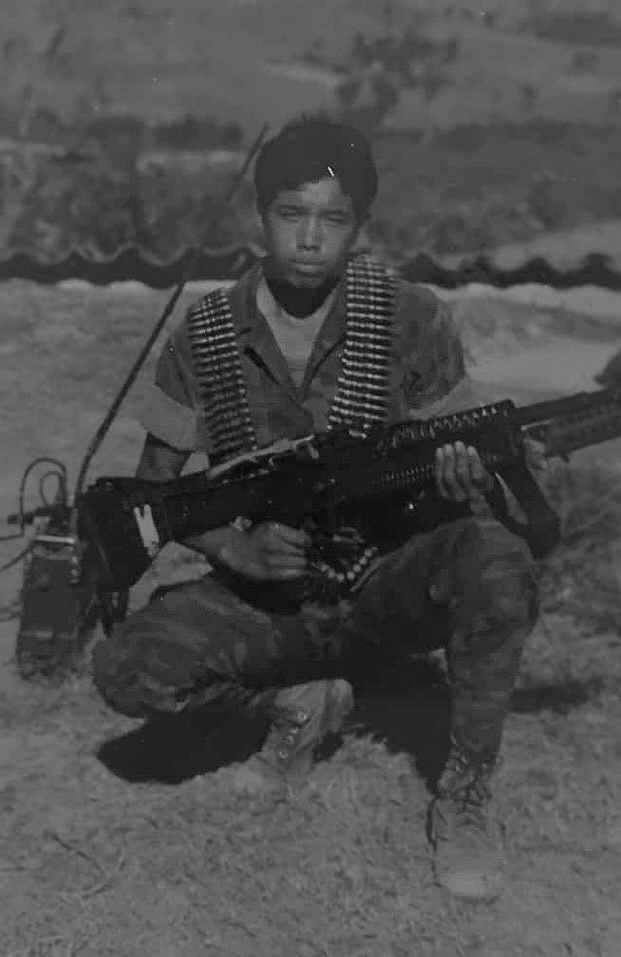
Orbelina’s brother, Jorge Ulises, was killed in El Salvador not long after by the same kind of violence.
He was thirty-eight years old, with four children, moving between the two countries with the ease of someone who had built a life on both sides. The night before he left, he called their brother Carlos to wish him a happy birthday.
“Feliz cumpleaños, bro. I’ll see you in Los Angeles soon. Or maybe you meet me in Texas. Soon.”
Twenty-five bullets. The same number that killed their father during the civil war.
Fighting back tears, “You return to relive every moment—it’s like a knife. Why? Why did this happen to him?”
As best the family could piece together, this was old resentment settling into the only grammar available.
***
Three generations. Her father, taken by the guerrilla fighters on his own coffee farm in Zacaderas, El Salvador, 1980. Alvarito, taken on a November afternoon on a street in Los Angeles, 2007. Her brother—taken by the gangs on the highway in El Salvador, 2009.
There is no way to describe the pain of someone who has seen the same violence, that same heartache, move through three generations unchanged. She does not speak in abstract terms about the thread connecting these deaths.
“From here, they deported them—those that had built (the gang) back there. And they began to grab boys as young as nine-years-old to put them in the gangs.
During the civil war, she says, people simply vanished.
“They disappeared. They simply disappeared. You were lucky if they found your body. And if they found your body, they would find you naked and disfigured.”
The gangs worked the same way. Different uniforms. The same silence where a person used to be. With the same lack of dignity for those whose bodies are “lucky” to be found.
In March 2022, following a weekend in which 87 people were murdered, Salvadoran President Nayib Bukele declared a state of exception, suspending constitutional rights and launching the most sweeping gang crackdown in the country’s history. Over 91,000 people have since been arrested. The murder rate dropped from 53 per 100,000 people in 2018 to 2.4 per 100,000 in 2023. For the Salvadoran diaspora in Los Angeles, many of whom had spent decades watching their country bleed, it was the first thing that had worked.
Author and University of Southern California Professor of Anthropology Thomas W. Ward has spent his career sitting within that void. He has interviewed more than 150 members across eight cliques, from the streets of Los Angeles to prisons in California and El Salvador. Drinking with gang members at parties, baking them birthday cakes, and visiting them in hospitals after they were shot. Attending too many funerals.
They’ve told him about their dreams and their motivations. He had a gun put to his head and a knife held to his throat. He has stayed anyway. What he was looking for, he said, was not the gang. It was the human being inside it.
Through meditative practice and direct mentorship, Ward works with the young men most institutions have written off. He knows first-hand how “many people deny them their humanity… deny them potential. [Society] doesn’t see the multiple problems these youth have faced… People don’t really care and see them as lost causes.” Ward knows that “no amount of gang suppression and incarceration is going to solve the problem. People like simple answers.”
There aren’t any.
But Ward is not without hope. “It’s never too late. Any effort is better than no effort. You do the best you can do, on an individual and a societal level, and then pray for a good outcome.”
Orbelina watches Bukele’s crackdown: the packed prisons, the sentences piling up to hundreds of years. She knows the arguments about due process, about mass incarceration, and about the risk of a cure that resembles the disease.
“Those who complain about human rights never came to ask us—‘How do you feel?’ These people are always criticizing Bukele for having thrown these ‘little angels’ into jails. But no one came to ask: ‘How do you who have lost your loved ones feel?’ None of these ‘humanitarians’ cry for those whom these beasts have killed.”
Salvadorans in Los Angeles now speak about their country differently than they did ten years ago. Something has shifted in what it means to say the name of their home.
“A lot of people are very proud to be Salvadorian. Especially with Bukele.”
Her brother Carlos still travels back. He carries both worlds with him. He declined to speak for this piece. Orbelina has never gone back.
“Because of all I’m seeing today, I’m afraid for the future in this country. Perhaps some people will say my experiences in El Salvador have colored my impressions of what is happening here. But they’re wrong. What kind of world will there be for the generations to come?”
***
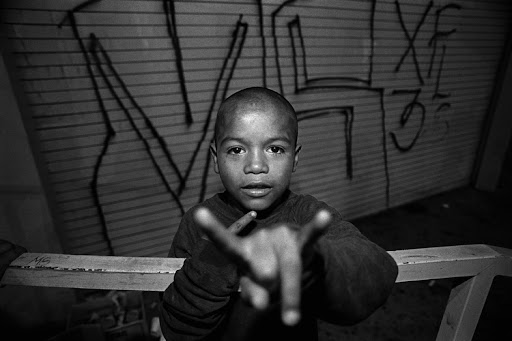
A particular kind of loneliness marks this story. It is the loneliness of a mother pushing her daughter toward a plane bound north to a foreign land. Of a young man drowning in his own blood on a public sidewalk, while no one helped. Of children growing up in families where fathers and brothers disappear, to the guerrilleros, to the gangs, to the state, and do not come back.
It is the loneliness that makes a nine-year-old boy recruitable on his way to school. Because someone saw the void in him before anyone else did, and moved on it first.
Orbelina is not a policymaker or a researcher. She is a woman who has buried three generations of men she loved.
Orbelina asked for this to be the final line:
“I remain hopeful because I always believe that there will be a tomorrow. The sun always rises. I place my trust and faith in God that there will always be a new dawn. May God bless this country for being the place where the entire world and immigrants like me find what we need.”